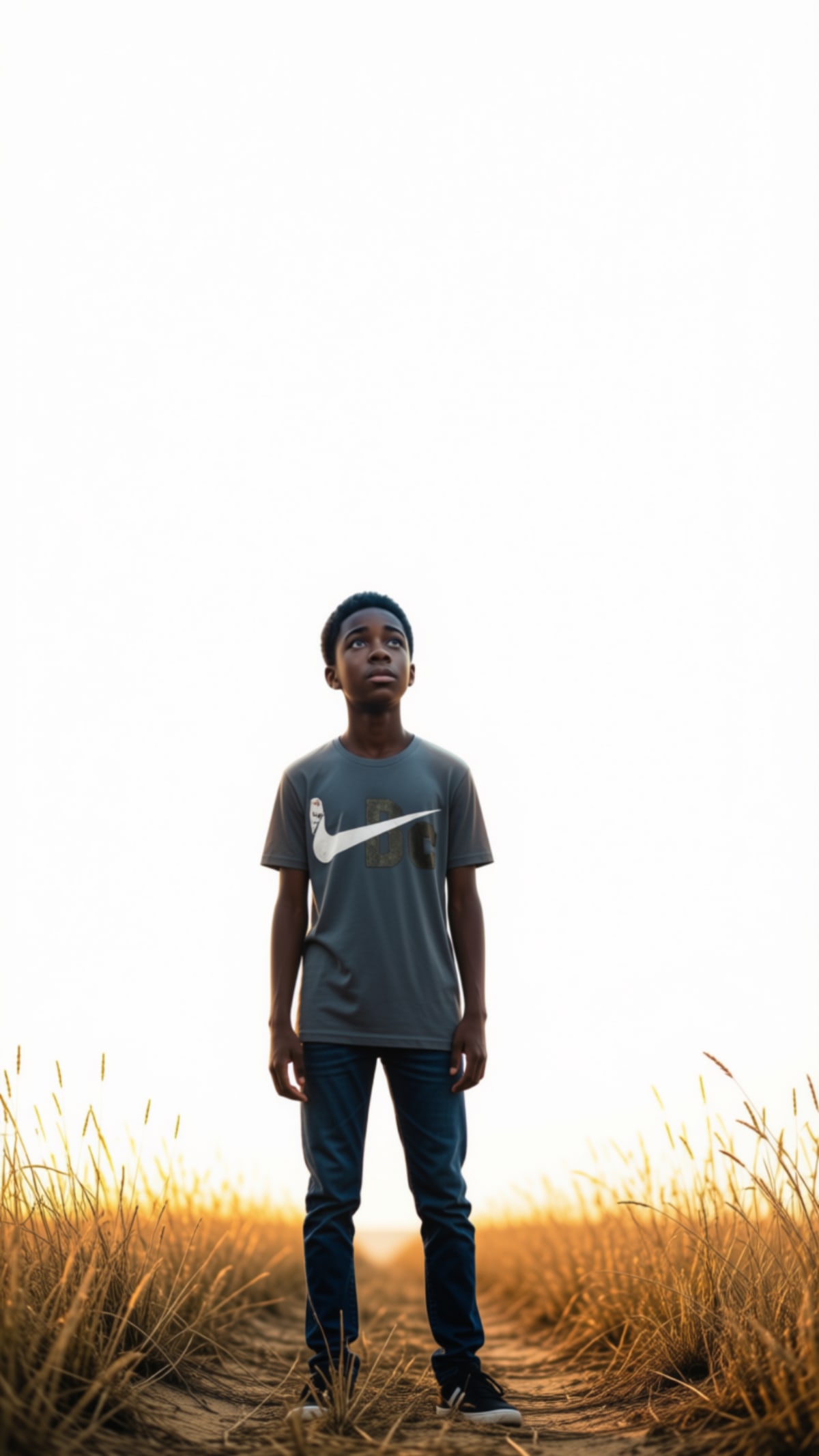

Planet of the Races: Episode 2—When the Sky Called His Name expands kineyã’s science-fiction world into a deeply personal story about grief, family, dignity, faith, and the right to be seen as fully human. At the center is Roni Joseph, a gifted Black teenager from Opelousas, Louisiana, whose hard life has taught him that circumstances can shape a person—but they do not have to define who that person becomes.
When the sky calls Roni’s name, it does not simply summon him into an interstellar adventure. It places an ordinary neighborhood kid at the center of a global first-contact crisis and asks whether humanity is prepared to become worthy of peace.
Roni Joseph’s Story
Roni Joseph is not introduced as a chosen one who has lived an easy or protected life. He is a young man from Opelousas who has seen hardship up close. He has lived with loss, family pressure, limited expectations, and the daily weight placed on Black boys growing up in communities too often judged from the outside.
His father has been taken by war. His older brother struggles with addiction and represents a path Roni refuses to follow. Roni could have allowed pain, frustration, and the expectations of others to push him toward becoming a thug, gangster, hoodrat, or drug user. Instead, he chooses something different.
He chooses to remain decent.
Roni wants more from life. He wants to rise beyond the circumstances surrounding him. Most of all, he wants his mother to be proud of him.
That desire gives the novel its emotional center. Roni does not seek greatness simply for fame, power, or escape. He wants to prove that a child from a difficult neighborhood can make choices rooted in purpose, intelligence, compassion, and self-respect. His strength is not that he has never known hardship. His strength is that he refuses to let hardship turn him into someone he does not want to be.
First Contact and Human Worth
The Laranians arrive not as conquerors, but as observers of a divided world—a species capable of beauty, science, family, and devastating cruelty. Their offer is hopeful, but unsettling: selected children from Earth will travel to Lara to learn the conditions necessary for peace, while humanity is given a limited opportunity to confront its own divisions.
Roni’s opportunity to travel to Lara is not only a personal dream. It becomes a chance for him to represent people whose lives are regularly ignored, stereotyped, or softened for public comfort. He carries the voices of his neighborhood, his family, and young people who are too often treated as statistics before anyone asks who they are.
A hit-and-run leaves Roni paralyzed, appearing to end his dream before it can begin. His later healing and selection for the mission make him a symbol, but the novel is strongest when it remembers that Roni is first a son and a child. His value cannot depend on whether he can walk, become a hero, or meet someone else’s definition of success.
His worth has always been there.
Louisiana at the Center
One of the novel’s strongest choices is placing the epicenter of interstellar history in Opelousas, Louisiana, rather than in a generic military base, laboratory, or distant political capital.
Opelousas is not treated as a backdrop. It is a place shaped by memory, faith, family, community, endurance, and a long history of powerful outsiders arriving with demands, promises, and expectations. The city’s residents insist that they will not be reduced to background characters while an event of world-changing importance unfolds on their own land.
The descent of a mile-wide Laranian vessel over southern Louisiana creates the novel’s central image: the future does not arrive somewhere else. It arrives over a community that has already learned to survive abandonment, judgment, and unequal power.
Commander J’kote’s question—“Which of you speaks for Earth?”—cuts through the spectacle. It challenges governments, military officials, and ordinary people alike to confront the difference between official authority and moral legitimacy.
Power, Truth, and Peace
When the Sky Called His Name is not escapist science fiction. It examines surveillance, militarized secrecy, political manipulation, and the tendency of institutions to treat vulnerable people as resources instead of human beings.
The DiGital⧗uNdeRgRouNd—a network of coders, veterans, archivists, church members, and ordinary citizens—offers a different model of power. It is built around documentation, mutual aid, community memory, and truth-telling. Rather than allowing governments or powerful institutions to control the story of first contact, the network works to keep information in the hands of the people.
The Laranians’ message frames peace as more than the absence of war. Peace requires accountability, unity, protection of the vulnerable, and a willingness to transform the systems that produce division.
ThemeRole in the novelPeace | The Laranians challenge humanity to understand peace as an ethical discipline, not merely a political agreement.
Family | Roni’s love for his mother and his complicated relationship with his brother give the cosmic story personal stakes.
Dignity | Roni’s life affirms that a person’s worth is not determined by neighborhood, income, race, trauma, or physical ability.
Truth | The DiGital⧗uNdeRgRouNd resists secrecy and insists that ordinary people deserve to know what power is doing.
Choice | Roni’s refusal to become a product of destructive expectations shows that difficult circumstances do not erase agency.
A Call Beyond the Stars
The prose of Planet of the Races: Episode 2 is cinematic, direct, and morally engaged. It names injustice clearly and insists that Black children, Black families, and Black communities belong at the center of the future—not as casualties, side characters, or symbols, but as decision-makers, survivors, dreamers, and leaders.
The novel’s central question is not whether aliens can save humanity.
It is whether humanity can learn to save itself.
Roni Joseph’s selection gives the title its deeper meaning. The sky calls one young man by name, but the call reaches beyond him. It is a challenge to every reader: Will we remain divided spectators of the future, or will we help build a future worthy of the children who must inherit it?
For Roni, the answer begins with a simple but powerful determination: to rise above what life has placed before him, to remain a decent human being, and to make his mother proud.