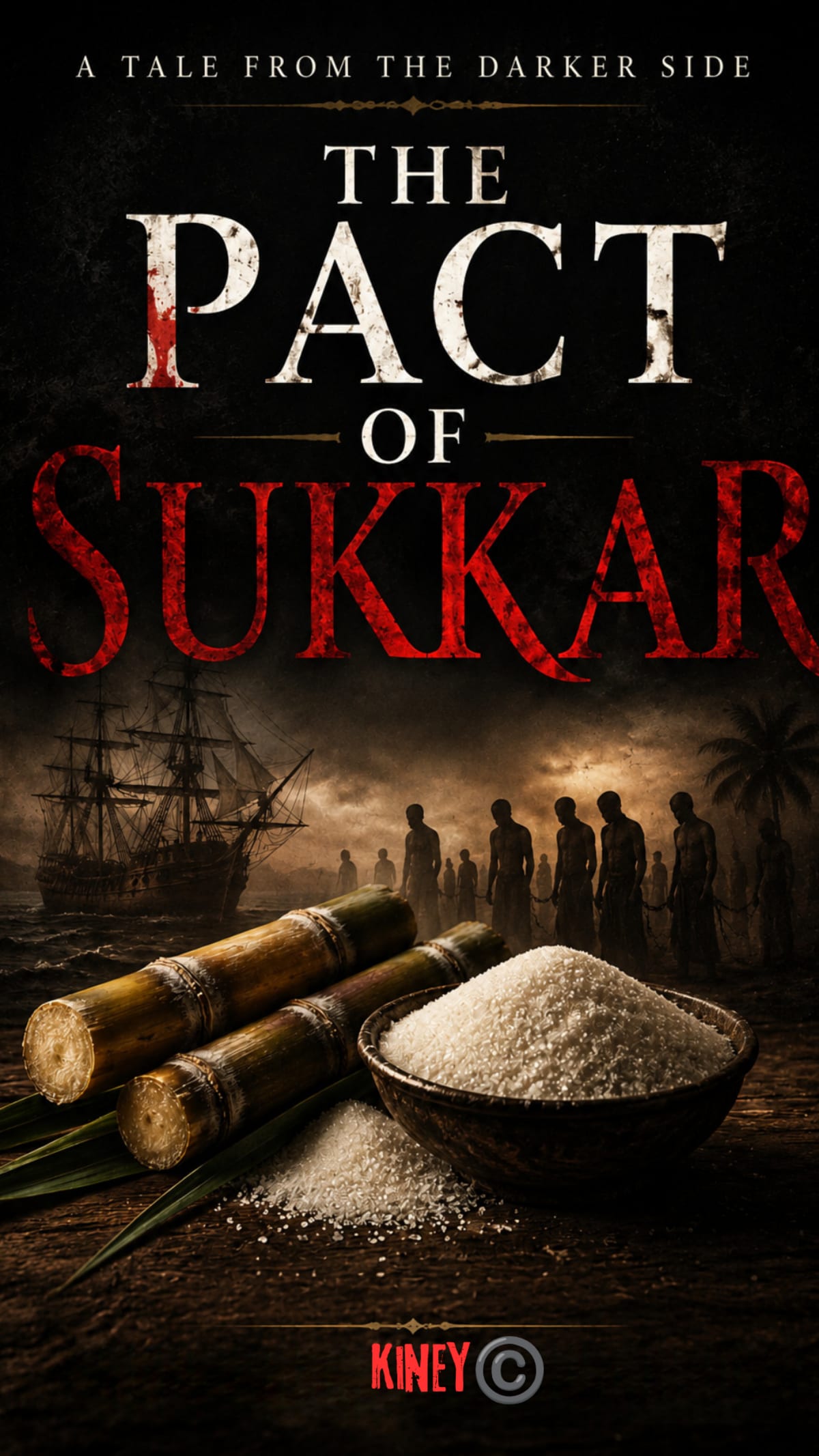
The Pact of Sukkar: A Tale From the Darker Side is a historical Gothic-horror novel that transforms sugar into a symbol of conquest, enslavement, greed, and spiritual corruption. In the same way tobacco and cotton became pillars of colonial wealth—commodities whose profits depended on land theft, forced labor, and systems of racial hierarchy—sugar in The Pact of Sukkar carries an ominous history beneath its sweetness.
The novel’s central question is simple and disturbing: What happens when the comforts people enjoy are built upon suffering they have been taught not to see?
This is not horror driven only by demons, violence, or supernatural spectacle. Its deepest terror comes from the realization that the demon within the cane does not invent human cruelty. It finds human beings and institutions already prepared to bless it, organize it, profit from it, and call it progress.
Sweetness, Cotton, and Tobacco
Sugar, tobacco, and cotton each became more than agricultural products in the history of empire. They became instruments of expansion.
Tobacco helped fuel the growth of colonial plantations and the demand for enslaved labor. Cotton became central to industrial wealth while tying the economies of the American South, Northern financiers, European mills, and global trade to the labor of enslaved African people. Sugar built immense fortunes throughout the Caribbean and the Americas, turning islands and fertile land into machines designed to produce sweetness for distant consumers.
In The Pact of Sukkar, kiney draws from that painful legacy. Sugar is not merely an ingredient, a luxury, or a crop. It is an appetite—a force that transforms land into property, people into labor, culture into an obstacle, and suffering into a line item on a ledger.
The novel asks readers to look beyond the spoonful of sweetness. Like tobacco and cotton, sugar becomes a reminder that ordinary comforts can possess extraordinary histories.
A Pact With Conquest
The novel opens with Captain Elias Thorne arriving on a lush island and encountering sukkar, a sacred crystalline sweetness connected to the land, ritual, healing, and balance. When Thorne tastes it, he enters a pact with a malevolent force that offers wealth, status, influence, and dominion.
The price is devastating: the destruction of the island’s autonomy, people, and spiritual balance.
From that moment forward, sugar becomes an engine of conquest. The demon of sukkar speaks not only through darkness and curses, but through the respectable language of empire:
Contracts.
Scripture.
Flags.
Ledgers.
Law.
Trade.
Property.
“Civilization.”
One of the novel’s most unsettling ideas is that demons do not always arrive with claws, horns, smoke, or monstrous faces. Sometimes they arrive through polished words carefully placed over unbearable things.
The Church’s Shadow
The novel does not spare religious authority from its examination of empire. The Holy Church, through its sponsorship, blessing, and moral influence, becomes part of the machinery that makes conquest appear righteous.
Church power offers colonial expansion a spiritual vocabulary. It can frame invasion as salvation, dispossession as divine order, forced conversion as rescue, and obedience to empire as obedience to God. In this world, faith becomes vulnerable to being used as a seal of approval for violence.
This does not mean that spirituality itself is the villain. Rather, The Pact of Sukkar examines what happens when sacred language is taken hostage by wealth, political ambition, and racial domination.
The chapel, the saints, the scripture, and the rituals of the Church become Gothic images because they stand beside suffering rather than against it. Sugar dust settles over carved saints. A house of worship becomes a place of judgment. The sacred is stained by the very institutions claiming to defend it.
Empire as the Monster
Captain Elias Thorne is brutal, ambitious, and morally hollow, but he is not the novel’s only monster. The larger antagonist is the architecture of power built around him:
Merchants seeking profit.
Military forces enforcing possession.
Plantation managers demanding production.
Legal systems redefining theft as ownership.
Church authorities granting moral cover.
Consumers enjoying the sweetness without seeing the suffering behind it.
kiney presents colonization as a process of renaming. Land becomes a “holding,” “concession,” or “property.” Theft becomes order. Forced labor becomes productivity. Enslavement becomes administration. Indigenous sovereignty is dismissed through legal and theological claims that define the conquered as unworthy of governing themselves.
The supernatural does not replace this critique. It makes it impossible to ignore.
The demon of sukkar represents an appetite that society has already embraced: the desire to make luxury ordinary and profit invisible by forcing someone else to carry the cost.
Memory as Resistance
Against the machinery of sugar stand Nala and other survivors who preserve the truth through names, songs, testimonies, hidden documents, and collective remembrance.
Their resistance gives The Pact of Sukkar its deepest moral weight. The survivors may not always be able to stop the violence unfolding around them, but they resist the second violence that empire depends upon: erasure.
Empire wants the official record to be final. It wants conquest remembered as discovery, occupation remembered as settlement, and bondage remembered as labor. Nala and the survivors refuse that version of history.
Memory becomes an underground archive. To remember the names of the dead, to preserve a song, to hide a document, or to tell the truth to the next generation becomes an act of survival.
A Darker Kind of Horror
kiney’s prose is lyrical, incantatory, and deliberately severe. Short lines and repeated phrases give the novel the cadence of a warning, a confession, or a sermon. The history of sugar becomes “sweetness refined from suffering.”
The Gothic imagery is especially powerful because it is tied to systems rather than isolated scares:
Sugar dust coating the faces of carved saints.
A chapel transformed into a site of judgment.
The mill turning long after darkness falls.
The dead returning as the unacknowledged foundation of wealth.
The sacred cane becoming the vessel for a curse that feeds on human greed.
Readers seeking a quiet historical allegory may find the novel’s moral argument forceful. But that forcefulness is intentional. The Pact of Sukkar refuses to soften the language of historical brutality simply to make it more comfortable for the reader.
Final Thought
The Pact of Sukkar is a dark, imaginative, and politically urgent work of historical horror. By placing sugar beside the legacies of tobacco and cotton, the novel exposes how empires turned land, labor, faith, and human lives into commodities.
Its most unsettling claim is also its most powerful:
The demon is not only in the cane. It is in every institution—and every individual—willing to call conquest discovery, bondage labor, theft ownership, and greed progress.
By making this history supernatural, kiney does not make it less real. He makes the moral violence beneath ordinary sweetness impossible to ignore.
September 10, 2026
The Pact of Sukkar: The Bitter History Behind Sweetness