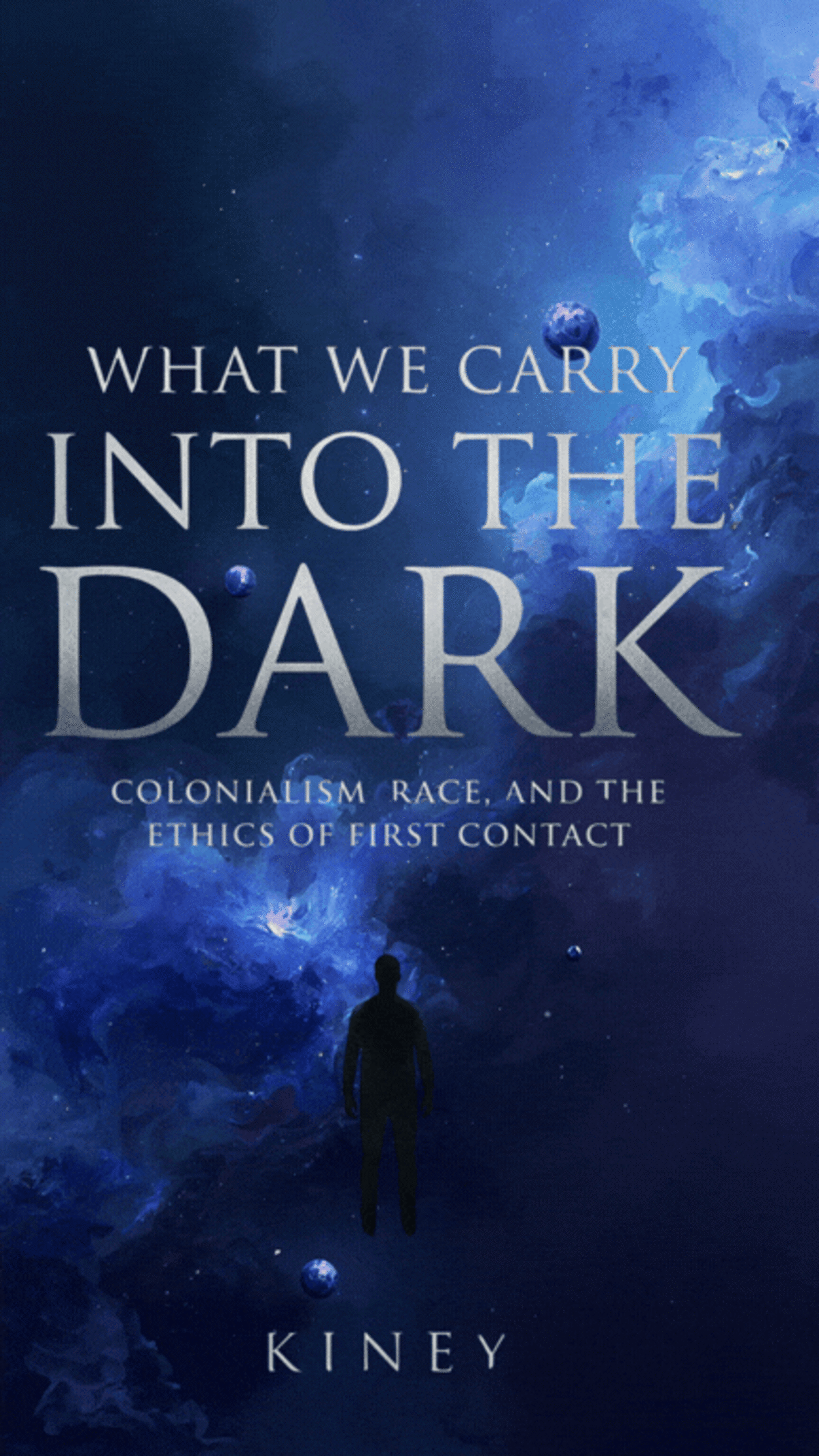
What We Carry Into the Dark: Colonialism, Race, and the Ethics of First Contact is not simply a book about aliens, distant planets, or the possibility of life beyond Earth. It is a question humanity must answer before it carries its oldest habits into a new frontier:
If we encounter another intelligent life form, what will we bring with us—curiosity and humility, or conquest, entitlement, fear, and domination?
This work of speculative nonfiction asks readers to reconsider the moral meaning of humanity’s movement into space. Its argument is urgent and clear: before imagining how we might meet extraterrestrial intelligence, we must confront the colonial, racial, economic, and militarized patterns that have shaped human history on Earth.
First Contact Begins Here
Too often, first contact is treated as a technological puzzle or a science-fiction spectacle. Will an alien civilization be friendly? Will it be hostile? Will humanity be prepared to defend itself?
But the deeper question is not whether humanity has the technology to reach the stars. The deeper question is whether humanity has developed the ethical maturity to meet the unfamiliar without trying to control, exploit, categorize, or destroy it.
A civilization that cannot consistently practice dignity, reciprocity, justice, and accountability among its own people may be poorly prepared to meet a profoundly unfamiliar “other.” First contact, therefore, does not begin when an alien signal reaches Earth. It begins now—in the ways societies distribute power, define humanity, govern shared resources, and respond to people who have historically been marginalized.
The Baggage We Carry
The book examines how words often used in conversations about space exploration—“frontier,” “settlement,” “development,” “discovery,” and “manifest destiny”—can carry older assumptions about possession, entitlement, and conquest.
The point is not that all space exploration is automatically colonial. Human curiosity, scientific exploration, and the search for knowledge can be noble pursuits. But history teaches that exploration becomes dangerous when wealth, technology, decision-making, and military power are concentrated in the hands of a few.
When that happens, discovery can become extraction. Settlement can become displacement. Security can become occupation. Progress can become another name for the right of the powerful to decide who belongs, who benefits, and who is sacrificed.
The question is not merely whether humanity can reach another world. It is whether humanity can do so without recreating the violence that has followed conquest throughout history.
Ethics Before Extraction
One of the book’s central strengths is its attention to Indigenous land-right principles and their relevance to planetary governance. Values such as relationality, stewardship, reciprocity, co-governance, and Free, Prior, and Informed Consent offer more than symbolic language for future space policy.
They provide an ethical foundation for thinking about shared worlds, shared resources, and the rights of communities affected by powerful institutions. These principles challenge the idea that technological capability automatically creates moral permission.
Before extraction comes consent.
Before expansion comes accountability.
Before claiming a new world comes the responsibility to ask whether humanity has learned how to share its own.
This is where the book moves beyond criticism. It calls for enforceable systems of governance that place dignity, consent, transparency, and responsibility ahead of profit, competition, or national power.
A Future That Includes Us
The book also draws on Star Trek as both inspiration and critique. The Prime Directive—the principle of noninterference—becomes a way to examine power imbalance, cultural autonomy, and the distance between idealistic futures and present-day realities.
For many readers, science fiction has promised a future of exploration, cooperation, and discovery. Yet Black people, Indigenous people, colonized people, and other marginalized communities have often been absent, minimized, or treated as secondary in the imagined future.
That absence matters.
Representation is not just a cultural concern. It shapes who is imagined as belonging in the future, who is viewed as capable of leadership, whose knowledge is valued, and whose survival is considered worth protecting. A future that excludes people from its imagination is already repeating the failures of the past.
The universe is not a frontier waiting to be claimed. It is a commons humanity has not yet learned to deserve.
The Real Question
What We Carry Into the Dark brings together military experience, Black history, Indigenous rights, colonial critique, space law, political thought, and science-fiction philosophy. It challenges readers to understand that history is not distant background. It remains active in the language societies use, the institutions they build, and the futures they dare to imagine.
This is not conventional science writing, and it is not a simple celebration of space exploration. It is a moral reckoning.
Its most important insight is simple but demanding:
First contact begins long before an alien signal arrives. It begins with how humanity treats one another on Earth.
The real question is not whether humanity can reach the stars.
The real question is whether we have done the work required to arrive there responsibly.
September 10, 2026
What We Carry Into the Dark: A Question Humanity Must Answer