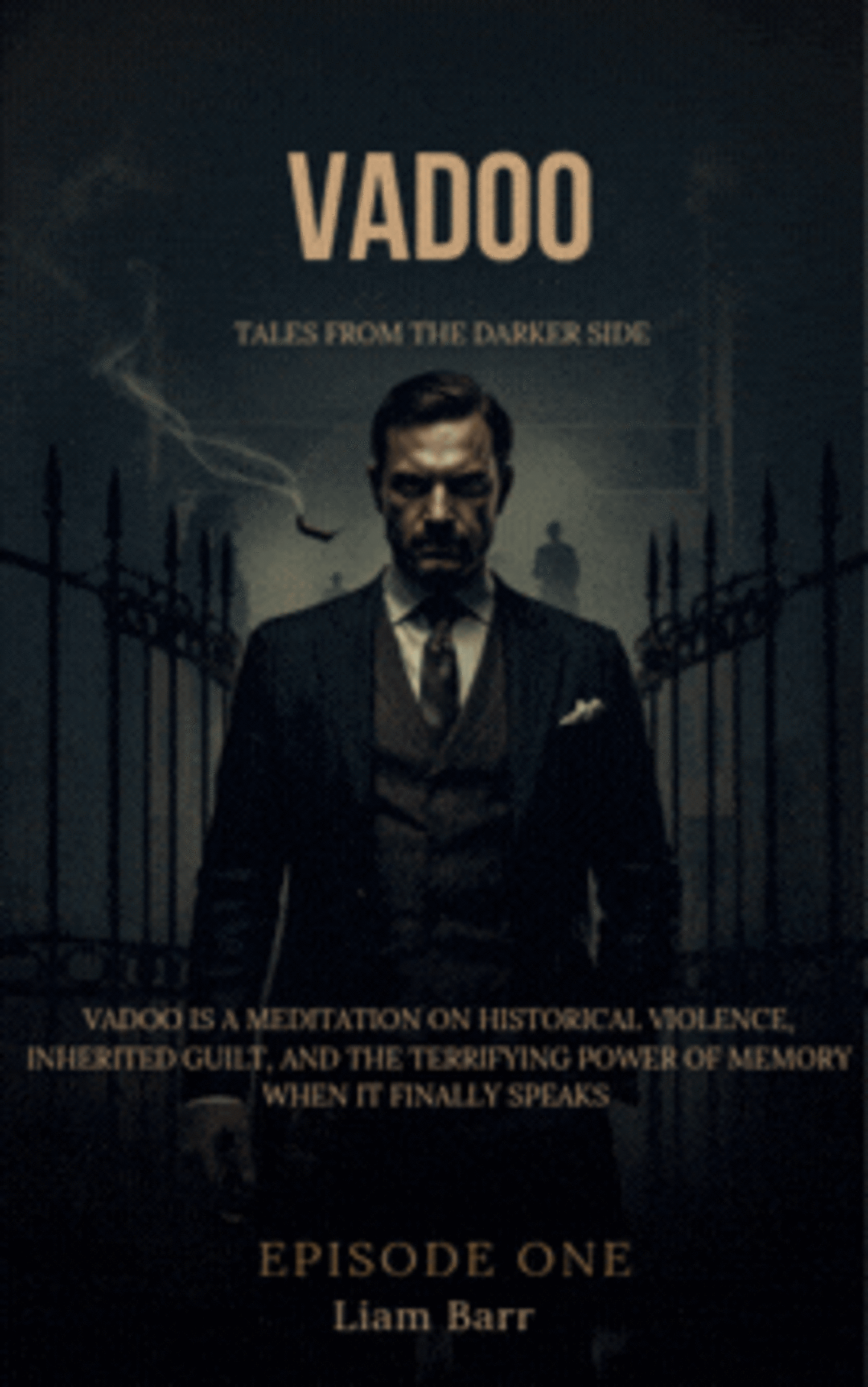
Vadoo: Tales From the Darker Side is a work of Black Sci-Fi, horror, and social reckoning. Its title may sound familiar to readers who associate it with “Voodoo,” but Vadoo is its own fictional creation: a dark, imaginative story that uses supernatural consequence to confront racism, violence, greed, inherited fear, and the systems that protect power.
This is not a book about reducing African-derived spiritual traditions to horror imagery. It is a novel about what happens when hatred creates a nightmare so complete that the person who once benefited from racial privilege is forced to confront the world he helped sustain.
A Curse of Blood and Land
At the center of Vadoo is Liam Barr, a white man living in Delcroix, Louisiana. His bigotry toward his Black neighbors—the Washington family—turns into greed when he discovers that land he sold them may contain valuable mineral deposits.
Liam’s prejudice becomes deadly. His actions lead to a fatal collision that kills Bobby, Camille, and Marci Washington, setting a supernatural reckoning into motion. Lorena Joseph’s final words—“Let him enter what he made”—become both a curse and a judgment.
The next morning, Liam awakens to find that he and his entire family have been transformed. Their skin is now Black. The transformation is not a disguise, a costume, or a temporary spectacle. It is irreversible, and the real horror begins not with the change itself, but with how quickly the world around them changes.
Horror Beyond the Transformation
Liam’s former life depended on the protection of whiteness: his reputation, his social standing, his access to banking, his treatment by institutions, and the assumptions made in his favor. Once that protection disappears, the town of Delcroix reorganizes itself around him.
His family experiences exclusion in ways that are subtle, routine, and devastating:
Sherry cannot cash a check because bank employees question whether she is really herself.
Elise is pushed out of a prom-planning group chat and mocked with the racist label “voodoo princess.”
The Rotary banquet is postponed without explanation.
Old friends, neighbors, and institutions withdraw trust the moment the Barr family no longer appears white.
These scenes matter because they show that racial violence does not always arrive with a weapon, a mob, or a public spectacle. Often, it works through suspicion, exclusion, bureaucratic barriers, silence, and the steady removal of dignity.
The traffic-camera footage that reopens Bobby Washington’s death as a homicide investigation delivers one of the novel’s sharpest ironies. The same legal institutions Liam once trusted now treat him with distrust, examining his identity “as if fraud had become his natural condition.”
Vadoo, Not “Voodoo”
The title Vadoo should not be mistaken for Voodoo, Vodou, or any real spiritual practice. In the novel, Vadoo is a fictional framework created to serve the story’s themes of consequence, memory, fear, and moral accountability.
Real Vodou traditions, including Haitian Vodou and Louisiana Voodoo, are complex living belief systems with deep cultural, historical, and spiritual roots. They have often been misrepresented in popular culture as sinister, exotic, or purely supernatural. Vadoo: Tales From the Darker Side is not intended to define, explain, or speak for those traditions.
Instead, the novel uses a fictional supernatural force to ask a difficult question: What happens when a man is forced to live inside the fear, vulnerability, and violence he once imposed on others?
That distinction is important. Vadoo is not a religious text, a history of Vodou, or an attempt to sensationalize Black spirituality. It is speculative horror designed to expose the destructive power of racism and the moral cost of refusing to see another person’s humanity.
History as a Living Nightmare
The novel’s boldest choice is its descent into an antebellum nightmare that is not presented as a dream, vision, or symbolic detour. Liam and his family must survive it as a physically dangerous reality.
Miss Odessa’s instructions become a survival manual:
“Do not go out after dark. Do not travel alone. Never look white people in the eye.”
Those warnings force Liam to learn, in real time, what it means to live under constant threat. The hunting-camp sequence, in which Colonel Nugent and armed men pursue Liam’s family through the woods with dogs and searchlights, is especially harrowing because Liam experiences the terror he once dismissed as myth, “witchcraft,” or “Negro sorcery.”
Yet the novel refuses to make revenge feel simple or triumphant. When Liam kills Colonel Nugent and later holds three hunters at gunpoint, he recognizes that pain can reproduce the same violence it claims to resist. His suffering does not automatically make him good. It only removes the distance that allowed him to ignore the suffering of others.
A Reckoning, Not Redemption
Vadoo is not a comfortable redemption story about a racist man who suffers, learns a lesson, and earns forgiveness. Liam’s transformation exposes the moral failures of his family, his town, and the systems that once protected him.
His father, Chuck, reveals how far self-preservation can go when he treats his own son as “bait” for the hunters. Liam’s daughter, Elise, becomes a moral voice in the novel, refusing to let her father’s suffering erase the people who died because of his choices:
“I know Marci is dead. I know Bobby is dead. Camille is dead. And now the town knows you lied.”
The novel’s power lies in what it refuses to offer. There is no easy absolution. There is no clean separation between victimhood and responsibility. There is only the long, painful confrontation with the damage Liam caused—and the world he helped make possible.
Why Vadoo Matters
Like the strongest works of Black Sci-Fi, Vadoo: Tales From the Darker Side uses the impossible to reveal what is painfully real. It belongs in conversation with stories that use speculative displacement, horror, and altered reality to expose the unfinished history of race in America.
Where Octavia Butler’s Kindred sends a Black woman into the past to confront the living brutality of slavery, Vadoo reverses the direction. It forces a white supremacist into the consequences of the racial order he defended, making Blackness no longer an abstraction, stereotype, or target of contempt, but a lived condition of vulnerability within a hostile society.
Vadoo is a powerful read because it does not allow its supernatural premise to become simple poetic justice. Liam’s punishment does not purify him. It reveals him. More importantly, it reveals the machinery of racism within a family, a town, and a legal system willing to protect whiteness at nearly any cost.
For readers drawn to Black horror, social speculative fiction, historical reckoning, and stories that refuse easy answers, Vadoo: Tales From the Darker Side offers an unflinching challenge:
What happens when the fear a man weaponized against others becomes the only truth left standing in his own mirror?
September 10, 2026
Why Vadoo Is a Powerful Read—and Why It Is Not Voodoo