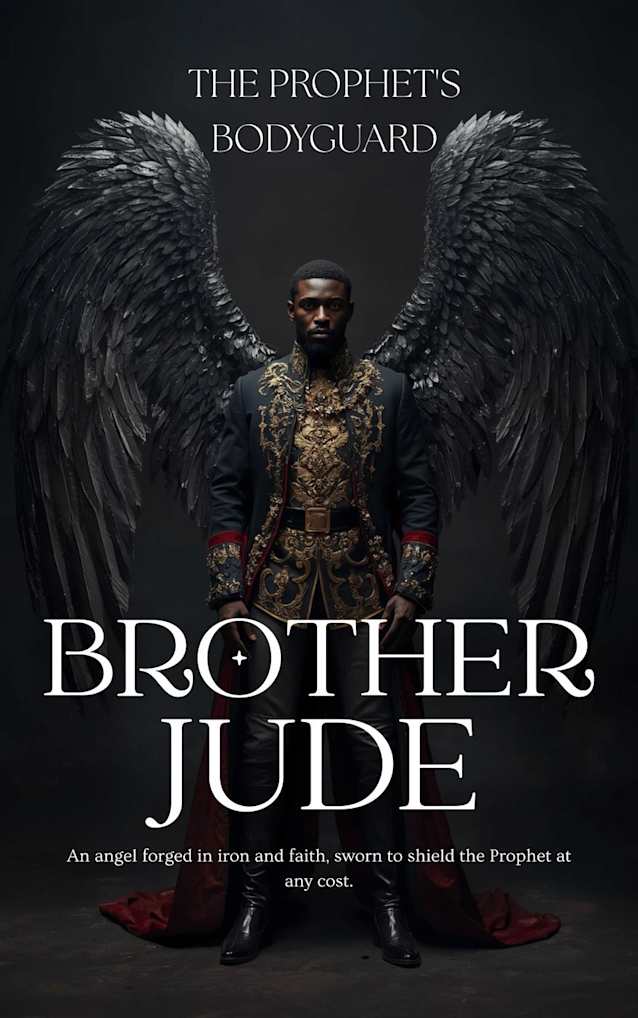
Brother Jude-The Prophet’s Bodyguard (Tales From The Darker Side, #2)
About
This novel says that evil is most dangerous when it stops looking like a person and starts looking like a system, and that truth survives only when communities keep naming the mechanism together. For Christian readers, it offers a story about deception, repentance, prophetic calling, and the long duty of guarding what is sacred even when history is distorted by fear and power. For non-Christian readers, it reads as a sweeping meditation on how hate mutates across centuries into policy, culture, and inherited assumptions that outlive their originators.
For Christian readers
Brother Jude’s journey speaks to the cost of betrayal, the possibility of redemption, and the burden of witness. It also insists that spiritual warfare is not only personal but structural, which means the battle is fought in institutions, narratives, and the stories communities tell themselves. The novel ultimately says that faith is not proven by certainty, but by the willingness to stand guard over the truth across generations.
For non-Christian readers
The book says that hatred becomes most powerful when it hides inside “normal” systems and no longer needs a single villain to keep functioning. It also argues that the work of resistance is not just exposing evil, but building memory strong enough to outlast it. Even without sharing the theology, a reader can recognize the novel’s central warning: when a society keeps repeating a false story long enough, it starts living inside it.
Shared message
To both audiences, the novel says that the true story matters because it changes what people are willing to tolerate. It asks readers to examine how fear is redirected, how blame is assigned, and how entire cultures can be shaped by a lie that feels useful. In that sense, the book is less about choosing between religious and secular meaning than about refusing to let hate define reality.
Trailer
Praise for this book
Brother Jude: The Prophet's Bodyguard is a sweeping work of Christian speculative fiction that takes one of the oldest human failures—betrayal for a promise never kept—and stretches it across two thousand years of guardianship, guilt, and service. It is kiney©️'s most theologically ambitious novel to date, using an immortal protagonist to trace how hatred adapts itself across centuries, from individual cruelty to something far more insidious: hatred embedded in systems.
A Betrayal That Bought Nothing
The novel opens in AD 33, in a village outside Jerusalem that no longer exists, destroyed by Roman soldiers searching for a Christian who had already fled. Standing in the ash of his own home, grief-stricken Jude hears a voice that speaks "in the grammar of his grief"—the demon Ma'as, also known as O'dium, meaning simply HATE. Ma'as offers Jude a bargain: betray the location of fellow Christians to Rome, and Rome's empire will fall in exchange.kiney©️'s handling of this premise is sharp on a crucial point of clarification: Jude is not Judas. They are two different men who committed the same act of betrayal, a deliberate doubling that widens the novel's scope beyond a single biblical figure into something closer to an archetype—ordinary human beings, in different times and places, choosing to sell out the vulnerable to power for a price. Jude's tragedy deepens when the promised outcome never materializes. Rome does not fall. He receives nothing for what he gave up except "the full weight of what he had become," as Ma'as withdraws "the way a fire withdraws when the fuel is gone."
Judgment as Choice, Not Compulsion
What distinguishes Jude's sentence from conventional damnation narratives is its structure. Rather than fury or eternal torment, his judgment arrives as "a quiet, sorrowful decree": he will walk the earth across every age and nation, standing beside those who carry sacred truth, shielding them with the life he once offered so carelessly—until "the next anointed one arrives." Crucially, kiney©️ insists this is not compulsion. Jude is given a genuine choice between walking in service or carrying the weight of his betrayal alone forever. He chooses service, and has been walking ever since.That distinction matters enormously to the novel's theology. This isn't a story about punishment imposed from outside; it's a story about redemption actively chosen and continuously re-chosen, century after century, failure after failure.
Twenty Centuries of Watching Hatred Evolve
The novel's historical sweep is genuinely impressive. Jude has served as bodyguard to prophets and truth-bearers across Carthage, Córdoba, Timbuktu, the slave ports of West Africa, the cotton fields of Mississippi, and the ruins of bombed churches, burned mosques, and shattered synagogues. He doesn't sleep in any ordinary sense—he prays continuously, in no fixed language, existing in "a state of presence" rather than petition. And crucially, he has failed. Ma'as is patient, multiform, and unpredictable, and Jude carries every failure forward, "one foot, then the other," until grief becomes bedrock beneath him.This accumulation of loss across millennia gives the novel its emotional gravity. Jude is not a triumphant warrior racking up victories; he is a witness to an enormous, ongoing catalogue of human cruelty, marked by the specific weight of having failed some of the people he was sent to protect.
Hatred Goes Institutional
The novel's most striking conceptual move arrives in its modern section. By 1999, Jude senses Ma'as preparing a civilization-scale offensive against America—a nation he recognizes as especially fertile ground precisely because of its unresolved contradiction between founding ideals and practices of exclusion and bondage. Tracking a child born in Baghdad at the dawn of the millennium, Jude eventually settles in Chicago, where he observes something new: Ma'as has evolved from possessing individual faces to embedding itself in impersonal systems—unequal schools, uneven policing, disparate healthcare. kiney©️ names this directly as "a theology of who mattered and who did not," constructed from thousands of small, seemingly administrative decisions.This is where Brother Jude connects most clearly to kiney©️'s broader catalog. Like TN, which locates violence in "the grammar" that makes certain harms administratively invisible, and like Game of Fallacies, which shows faith weaponized into institutional control, Brother Jude argues that evil's most dangerous modern form isn't a demon whispering in an alley—it's hatred dispersed across bureaucracy, policy, and infrastructure until no single person can be blamed for it.
Recognition in Chicago
Jude's modern arc gains its human anchor in Reverend Celestine, a sharp, decades-tenured Chicago pastor who immediately senses Jude is "not from this century" and carrying something ancient. Living without a fixed address, doing manual labor and food-pantry work, Jude occupies exactly the kind of invisible, unheralded existence the novel insists on honoring—one of "the guardians nobody wrote down."Final Assessment
Brother Jude: The Prophet's Bodyguard succeeds as a study in redemption through service rather than the erasure of guilt. Jude is never purified of his betrayal; he carries it as "sediment, becoming bedrock, becoming the ground he walked on." Instead of resolution, kiney©️ offers something more demanding and more honest: two thousand years of faithful, exhausting, largely invisible guardianship, offered in atonement to exactly the kind of people Jude once failed.The novel asks a question with obvious resonance across kiney©️'s work—what does genuine atonement look like when the harm can never be undone, only continually answered? By tracing hatred's evolution from a demon's whisper in AD 33 to a distributed system of exclusion in modern Chicago, Brother Jude earns its place alongside Game of Fallacies and TN as one of kiney©️'s most theologically and historically ambitious meditations on guilt, guardianship, and the long, unglamorous work of standing watch over truth.