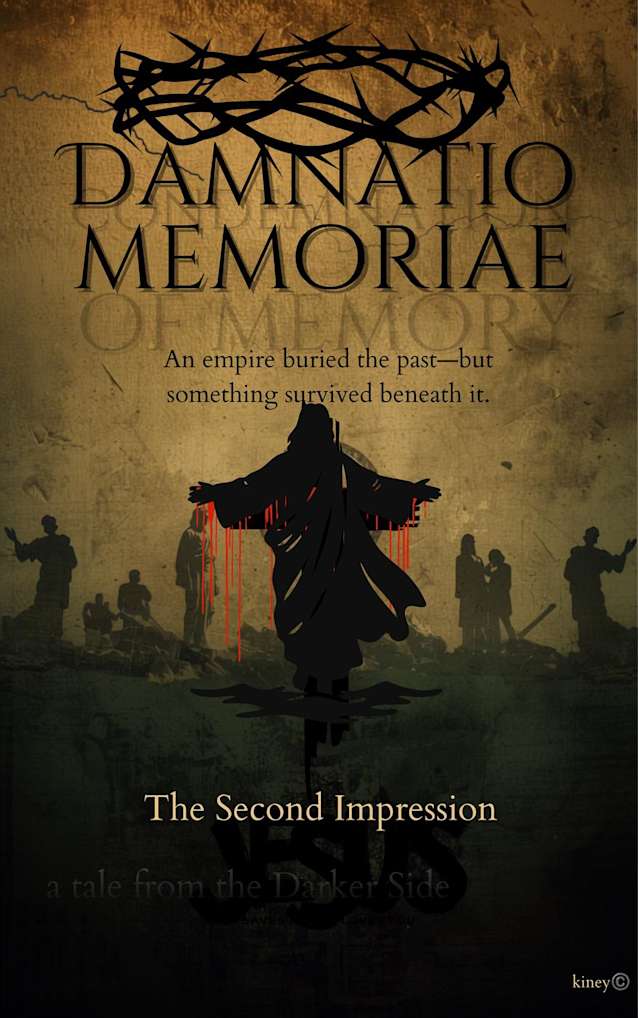
Damnatio Memoriae-The Second Impression (Tales From The Darker Side, #9)
About
Damnatio Memoriae: The Second Impression is a historical literary thriller about memory, empire, and the violence of narrative control. Set in Judea and Rome in the wake of an execution, the novel follows a printer, a Roman official, and a hidden archivist as they become entangled in competing accounts of the same death. When the first reports of the execution begin circulating, Eliab ben Seraiah, a Judean printer, realizes the story is already being shaped by power before it reaches the public. In Rome, Lucius Varro and Gaius Marcellus work to standardize the official version, refining contradictions into a single, useful account that can be repeated across provinces. But in the margins, Tirzah bat Nahaliel collects fragments, discarded drafts, and altered texts, preserving what authority wants forgotten. As the narrative spreads, it fractures and mutates. What begins as a contest over language becomes a struggle over history itself: who controls memory, who benefits from silence, and what happens when a lie becomes stable enough to be believed. Eliab, Marcellus, and Tirzah each confront the cost of repetition and the danger of certainty, while the world around them learns to live with a version of events that slowly hardens into inherited truth.
Praise for this book
Damnatio Memoriae: The Second Impression takes its title from an actual Roman practice — the formal erasure of a person's memory from public record — and turns it into the organizing principle of a historical literary thriller about who controls the story of an execution, and what survives once the official version hardens into history. It is one of kiney©️'s most structurally ambitious works, using three intertwined perspectives to dramatize the moment truth becomes negotiable.
Three Witnesses, One Contested Death
The novel is set in Judea and Rome in the immediate aftermath of an execution, and it follows three characters who each occupy a different relationship to the emerging narrative. Eliab ben Seraiah, a Judean printer, is the first to recognize that the story of the death is being shaped by power before it ever reaches the public — a chilling observation, since it means the "truth" people will eventually inherit was never neutral to begin with.In Rome, Lucius Varro and Gaius Marcellus take on the work of standardization: refining contradictions, smoothing inconsistencies, and constructing a single, repeatable account that can travel across the empire's provinces without friction. Their labor is bureaucratic rather than villainous on its face, which makes it more unsettling — kiney©️ frames the falsification of history not as a dramatic conspiracy, but as an administrative process, carried out by careful men doing their jobs.
Standing against that machinery is Tirzah bat Nahaliel, a hidden archivist who collects fragments, discarded drafts, and altered texts in the margins — preserving exactly what authority wants forgotten. Her quiet, patient resistance becomes the novel's moral center: the conviction that memory, however inconvenient, deserves to survive.
The Architecture of a Lie
What elevates Damnatio Memoriae beyond a simple morality tale is its interest in mechanism. The novel doesn't just assert that power distorts history — it shows the process by which a contested, fractured account of a death slowly stabilizes into something treated as settled fact. As the narrative spreads, it fractures and mutates, and what begins as a contest over language becomes a struggle over history itself: who controls memory, who benefits from silence, and what happens once a lie becomes stable enough to be believed.That focus on repetition as a mechanism of falsehood is the novel's sharpest insight. Eliab, Marcellus, and Tirzah each confront the cost of repetition and the danger of certainty, while the surrounding world learns, gradually and almost without noticing, to live inside a version of events that has hardened into inherited truth. kiney©️ is not simply telling a story about the past — he is showing readers the machinery by which any past becomes official, and how easily that machinery can be mistaken for objectivity once enough time has passed.