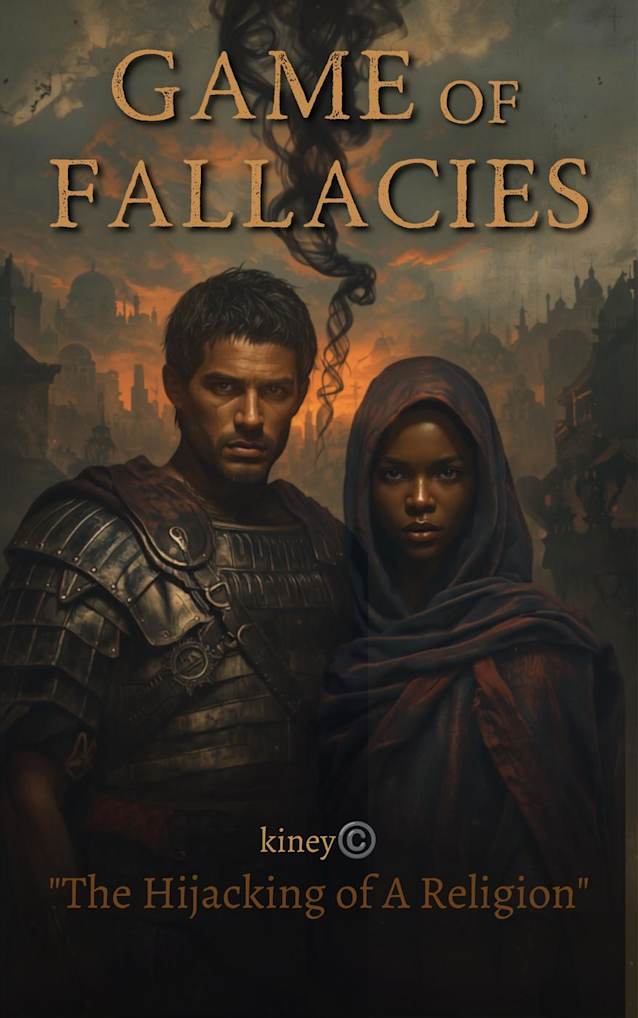
Game of Fallacies -The Hijacking of a Religion (Tales From The Darker Side, #5)
About
The Game of Fallacies is a story of faith undone, of hope surrendered in increments, and of the long, bruising journey toward self-knowledge.
At its center stands Centurion Marcus Valerius, a man divided against himself—driven by hunger, shadowed by duty, and bound to the dying wishes of his father: serve your nation, secure your name, and rise into the world clothed in honor, rank, and wealth. What begins as ambition hardens into pursuit. What begins as service bends slowly toward complicity. And with the aid of men whose loyalties are as uncertain as their morals, Marcus moves toward a destiny stained by history: a deception so vast it would outlive empires, a seizure not merely of power, but of belief itself. A religion, once born in spirit and sacrifice, is taken captive and remade in the image of men.
Across the ages, human beings have wrestled in silence with the things they claim to believe. Beneath doctrine, beneath ritual, beneath the inherited language of certainty, there is often a wound of doubt. It belongs not to the faithless alone, but to anyone who has ever searched the dark for meaning and found only the echo of their own questions. To examine one’s convictions is no small act. It is a kind of undoing. It strips away comfort. It unsettles the stories by which we have learned to live.
And always, somewhere in the private chambers of the mind, one question waits with terrible patience: What if the thing I have trusted most is founded on a lie?
It is the sort of thought that arrives uninvited in the stillness of night. It does not shout. It lingers. It presses. It stains peace with suspicion. Most people turn from it before it can fully take shape, before it can drag into the light the structures that hold their world together. For if one sacred truth begins to crack, what else might collapse with it?
This story walks willingly into that darkness. It dares to imagine that faith, in its passage through the hands of empire, ambition, and fear, may have been altered beyond recognition. That what was once tender, radical, and holy may have been seized, disciplined, and made useful. That the language of salvation may have been taught to kneel before conquest. That beneath the gold, the incense, and the sanctified performance of righteousness, something older and more violent was at work—reshaping belief into an instrument of rule.
From such corruption flow the familiar agonies of human history: racism draped in moral certainty, violence justified as divine will, slavery baptized as order, abuse hidden behind sacred authority, betrayal disguised as obedience. These are not aberrations standing apart from the story. They are among its darkest inheritances. They are the evidence of what happens when the soul of a thing is hollowed out and its body left standing.
Yet this is not merely an indictment of religion. It is a meditation on all corrupted systems of belief. Every ideology begins with a promise. Every institution claims a moral center. And yet, over time, even the purest vision can be consumed by power, deformed by fear, and guarded by those who profit from silence. What people call truth is often only the version that survived.
At its heart, The Game of Fallacies is a reimagined Christian horror story—one told not through spectacle alone, but through erosion: of certainty, of innocence, of the comforting boundaries between devotion and domination. It is a story meant to disturb. To grieve. To question. To follow the trembling line between reverence and manipulation until it disappears entirely.
So enter carefully.
What awaits is not simply a tale, but a reckoning.
Welcome to The Game of Fallacies.
Praise for this book
Game of Fallacies: The Hijacking of a Religion is one of kiney©️'s most ambitious works to date — a dark Christian speculative fiction thriller that reimagines the earliest institutional corruption of Christianity through the eyes of the man who helped engineer it. Rather than setting its speculative machinery in the future or in an alternate America, the novel reaches back to the crucible of the early Roman Empire, asking a question as unsettling as anything in kiney©️'s other work: what if the systems that hijacked a faith were not accidents of history, but the deliberate architecture of ambitious men?
A Centurion's Fall Disguised as a Rise
The novel follows Marcus Valerius, a Roman centurion driven by his father's dying wish that he elevate the family name through honor, wealth, and power. Marcus's path carries him from the battlefields of Judea into the political heart of Rome, where he falls under the influence of Arminius, a manipulator who teaches him a corrosive lesson: power does not belong to the truthful, but to those who can engineer belief, fear, and desire.That lesson becomes the engine of the entire novel. Marcus doesn't set out to corrupt a religion — he sets out to secure influence, and religion simply turns out to be the most effective instrument available. kiney©️ uses Marcus's gradual moral erosion to dramatize something history rarely narrates directly: the slow, deliberate process by which sincere faith gets reorganized into administration, confession gets repurposed into surveillance, and belief gets reshaped into hierarchy.
The Machinery of "The Word"
The novel's most chilling invention is "the Word" — the system Marcus and his ruthless ally Chapia Dora build together. It is not portrayed as an act of obvious villainy, which is precisely what makes it effective as speculative fiction. The Word rewards loyalty, punishes dissent, and teaches ordinary people to mistake domination for divine order. It is designed not merely to govern bodies, but to shape identity, inheritance, and belonging itself — a totalizing structure disguised as spiritual guidance.This is where Game of Fallacies earns its place as Black speculative fiction at its sharpest. Like Butler's Kindred or kiney©️'s own Vadoo and Reference Number 12007, the novel uses genre machinery to expose a historical mechanism that official narratives tend to soften or omit: the use of sacred language to justify domination. Here, the target isn't slavery directly, but the theological scaffolding that would later be used to justify it — the novel makes explicit that the corruption Marcus builds will not stay contained to his own era. It will "prepare the way for larger empires to weaponize religion across centuries — justifying conquest, dispossession, and greed in the language of salvation."
Resistance from the Margins
Crucially, the novel refuses to let institutional corruption go unanswered. Among the poor, the excluded, and the buried, a different current begins to rise — one rooted in authentic Christian witness, human dignity, and spiritual equality. This underground Christianity emerges through grief, resistance, and shared suffering, standing in direct opposition to the machinery Marcus has built.That structural choice mirrors a recurring pattern across kiney©️'s catalog: power constructs systems of control from above, while the people those systems are built to exploit generate resistance, memory, and truth from below. Where Reference Number 12007 centered a mother's plea against Jim Crow peonage and The Blob: The Other Side centered a segregated community's self-organized defense, Game of Fallacies locates that same dynamic at the very origin point of institutionalized Christianity — suggesting that the hijacking of faith and the hijacking of Black bodies in America are not unrelated phenomena, but branches of the same corrupted root.
A Tragic Architecture
Marcus's arc is ultimately tragic rather than triumphant. By the novel's end, he is forced to confront the devastating truth that the system he built was never sacred — only useful. That reckoning gives the novel its emotional weight: Marcus doesn't get the satisfaction of villainy fully realized or heroism belatedly discovered. He gets clarity, arriving too late to undo what he authored, and the knowledge that his corruption will echo far beyond his own lifetime.Final Assessment
Game of Fallacies: The Hijacking of a Religion succeeds as a haunting meditation on faith, ambition, betrayal, and the corruption of sacred ideas by political power. It asks difficult, historically resonant questions: how religions are manipulated, how institutions hollow out truth, and what remains of the human soul once belief has been converted into empire. Through Marcus Valerius's tragic rise and fall, kiney©️ delivers a novel that functions as both period thriller and moral indictment — a work that uses the earliest chapter of Christian history to illuminate patterns of institutional corruption that persisted for two thousand years afterward, and that readers of Kindred, Capitalism & Slavery, and kiney©️'s own Tales From the Darker Side series will recognize immediately as kindred territory.