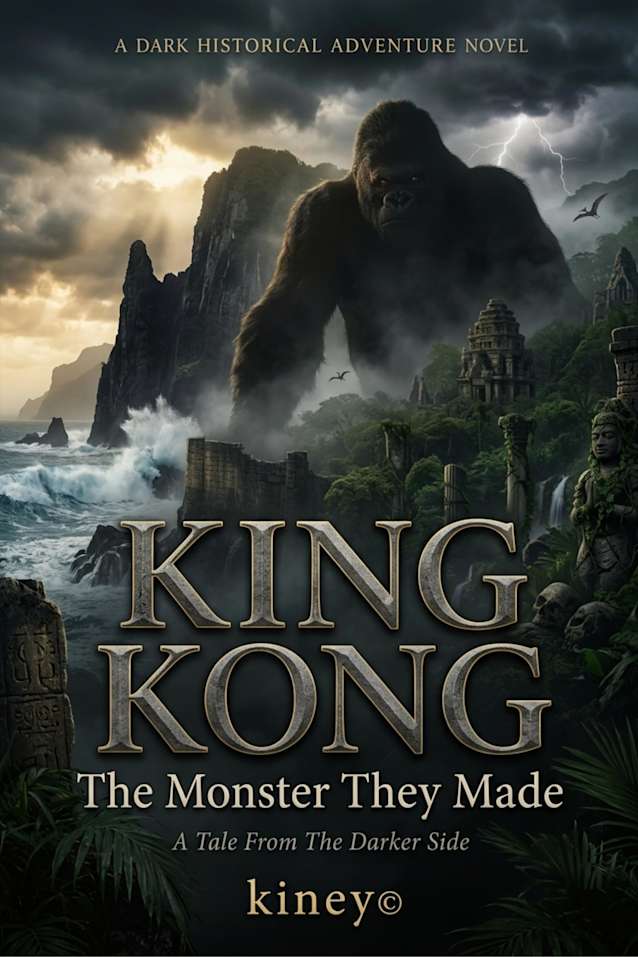
King Kong: The Monster They Made
About
1933. Hollywood sanitized the myth. The real story still hums beyond the fog.
In the depths of the Great Depression, ruthless visionary Kevin “Big Daddy” Joseph will stop at nothing to conquer Broadway with a cinematic masterpiece starring a Black actress. Backed by a diverse crew, advanced weaponry, and a stolen map, he charters the multi-purpose freighter Hikawa Maru into the uncharted Pacific. His target: Skull Island.
But a nervous, split-second mistake over a crackling phone line changes everything. Instead of the celebrated studio star Natalie Coleman, the crew mistakenly abducts Natasha, a struggling 23-year-old chorus girl dreaming of her big break.
Trapped at sea and forced into a harrowing rehearsal of fear, Natasha must navigate a cutthroat crew, the strict moral code of an underworld enforcer named Lil Smalls, and the haunting legacy of her own ancestry. For Skull Island is no mere myth, it is a forgotten fragment of the African diaspora, populated by the “People of the Fall,” and guarded by an ancient, 40-foot sovereign hybrid that remembers mankind’s oldest crimes: Kong
Perfect for fans of alternate history, historical pulp-noir, and speculative sci-fi, this gripping reimagining blends cinematic scale with profound historical depth. If you love stories that challenge legends and center forgotten voices, step into the fog of Skull Island today.
Trailer
Praise for this book
King Kong: The Monster They Made is an ambitious, revisionist reimagining of the Kong mythology that asks its most important question immediately: who was the real monster? kiney’s answer is not the giant ape on Skull Island, but the human systems that turn living beings, sacred places, and buried histories into spectacle, property, and profit.
Set against the racial and economic violence of the early twentieth century, the novel rebuilds the familiar King Kong story through Black perspectives, Black memory, and Black sovereignty. It is not merely an alternate version of a famous monster narrative; it is a deliberate confrontation with the colonial imagination that made that narrative possible.
A reclaimed mythology
kiney roots Skull Island in a radically different origin story. The People of the Fall descend from enslaved Africans, sailors, captives, and survivors of a 1710 shipwreck. Rather than reproducing the hierarchy of the world that cast them away, they form a society defined by hard-won freedom, collective memory, and the vow that no child born there will inherit a chain.This foundation gives the novel its moral power. Skull Island is not an “empty” frontier for outsiders to discover. It is a sovereign world with its own history, social order, language, dangers, and obligations. The island’s wall does not simply separate civilization from wilderness; it marks the boundary between a community that has survived empire and the ancient, untamed world beyond it.
Kong, in this telling, is neither mindless beast nor simple villain. He is a guardian figure—enormous, dangerous, intelligent, and shaped by loss. The people fear him, respect him, and recognize that their relationship to the island must be based on balance rather than domination.
Bessie Coleman’s reimagined survival on Skull Island is one of the novel’s most compelling creative choices. The historical aviator becomes “the Sky Woman,” a figure of courage whose arrival connects Black flight, Black possibility, African diasporic memory, and the island’s future. Her daughter Natasha inherits both the wound of her mother’s absence and the moral responsibility of learning what truly happened.
Kevin Joseph is perhaps the book’s most complicated character. A Black filmmaker moving through Depression-era Hollywood, he understands how white supremacy manufactures images, suppresses Black stories, and profits from racial fantasy. Yet he is also capable of reproducing exploitation in pursuit of his own ambition. His story becomes an examination of what happens when a person seeking liberation begins using the tools of spectacle, extraction, and control.
That moral contradiction gives the novel depth. Kevin does not operate as a simple antagonist; he embodies the peril of believing that access to power automatically makes its methods ethical.
The novel is most effective when it contrasts the language of discovery with the reality of invasion. Kevin’s observation that being “first” often means authorship through seizure captures the book’s central critique: in America, discovery frequently means the powerful arriving with money, weapons, cameras, or legal language and declaring ownership over something that was never theirs.
At times, the novel’s themes are stated with enough clarity that readers have little room to miss the political critique. But that directness is purposeful. The Monster They Made is not interested in neutrality; it is interested in exposing how “neutral” stories can preserve the moral assumptions of empire.
King Kong: The Monster They Made is a powerful work of Black speculative historical fiction that transforms a popular monster myth into an interrogation of race, capitalism, colonialism, memory, and storytelling. It restores dignity and complexity to people normally treated as scenery, restores agency to Black women erased from familiar narratives, and refuses to let Kong remain a convenient symbol of savagery.
The book’s enduring argument is simple: Kong was never the real monster. The monster was the worldview that saw an island as available for taking, a living guardian as a commodity, and the stories of Black people as material for someone else’s fame.