Operation Thunder (Tales From The Darker Side, #3)
About
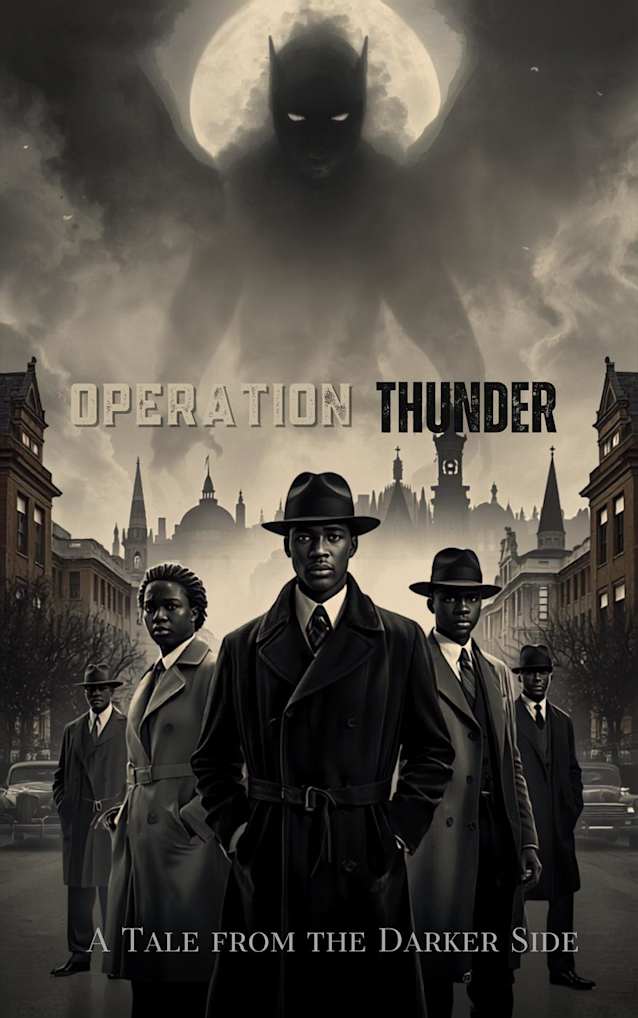
Operation Thunder — Tales from the Darker Side is a Black historical sci-fi thriller set primarily in 1943 Washington D.C. and New Orleans, following Joy Joseph, a twenty-one-year-old Howard University physics student whose father, the brilliant French-Haitian scientist Dr. Jerone Joseph, was secretly extracted from Nazi-occupied Europe and brought to Washington as a classified G-14 government contractor. Jerone had discovered a catastrophic atmospheric weapon — code-named Operation Thunder — based on massive, living jellyfish-like entities that drift in the upper atmosphere and, when weaponized and released, descend on populated areas and consume all life within them, feeding on destruction with no ability to be recalled or contained. The weapon was tested without Jerone’s consent on Folsom, Tennessee in July 1943, erasing a town of 2,200 people, a massacre the government buried as an industrial accident.
When a Nazi cell infiltrates Howard University’s campus — using two operatives from German South West Africa as cover — and attempts to kidnap Jerone to weaponize a rebuilt version of POP against the Port of New Orleans, Joy must use her father’s secret containment sequence, which she has carried in memory since age fourteen, to stop the deployment and save the city that supplies Allied troops, vessels, and war materiel to the entire Southern theater. She does not act alone — she operates through the Watchers, a multigenerational Black intelligence network rooted in Howard University, the Alpha Kappa Lambda Sigma sorority with secret OSS ties, and a web of community contacts running from Washington to New Orleans that the government has never been able to infiltrate, because it is built not on bureaucracy but on family. The novel’s ultimate argument is that the most important history is the history the powerful need you to forget — and the most enduring intelligence operation in American history was never a government program, but the quiet, unbroken chain of Black women who watched, remembered, and refused to let the truth disappear.
Operation Thunder is, at its core, a book about what happens when the darkness we try to outrun finally demands to be faced. It asks what people do when their secrets, fears, and unfinished pain stop hiding in the background and start shaping every choice they make.
For you as a reader, Operation Thunder isn’t just “scary” or “dark” for its own sake. It’s about the pressure building under ordinary lives—trauma, racism, power, faith, temptation, survival—and how that pressure turns into storms no one can control. The stories invite you to sit with the uncomfortable questions: Who do you become when you’re pushed to the edge? What parts of you are you willing to sacrifice to feel safe, seen, or in control?
The book is really about the thin line between victim and perpetrator, haunted and haunting, and how the past refuses to stay buried until someone is brave enough to name it. It speaks to readers who know something about carrying their own “thunder” inside—a grief, a rage, a secret—and want to see that weight reflected honestly on the page.
Praise for this book
Operation Thunder is one of kiney©️'s most tightly constructed thrillers—a work that fuses declassified-document horror, WWII espionage, and Black speculative fiction into a single, propulsive narrative. Framed by a chilling faux "casualty report" whose classification stamps and bureaucratic silences read like real archival material, the novel builds its horror from a single, devastating premise: what if weather itself could be weaponized, and what if the people best equipped to stop it were the ones history was least prepared to credit?
A Weapon Built from a Joke
The novel opens in December 1942, three floors below the Pentagon, where a throwaway political jab about Soviet weather research curdles into an actual research directive. From that flippant origin, "Operation Thunder" becomes the umbrella term for a series of buried War Department projects chasing one forbidden question: if weather can be predicted, can it also be produced? The device at the center of it all—POP, Positive Aerial Plankton—is the brainchild of Jerone Joseph, a French physicist whose theories on atmospheric charge fields were dismissed as speculative until the war made them dangerous.kiney©️'s prose in these opening pages is genuinely unsettling. The Folsom, New Mexico test sequence—clouds "blackening as if ink had been poured into them," forming "a mouth, a wound, a single enormous lung pulling the air itself thin"—reads with the same dread that runs through the novel's in-world casualty report, which cannot even settle on a fatality count and recommends the incident stay "sealed" pending "archival recovery." That formal ambiguity is the book's most effective device: the horror is real, but power's paperwork refuses to admit how real.
Joy Joseph: Intelligence as Inheritance
The novel's true center is Joy Joseph, Jerone's daughter, who inherits not just her father's scientific notation but the survival instincts of a family that has already lived through Europe's collapse once. Joy's introduction—tracking two German operatives posing as Howard University graduate students by reading the "trained invisibility" in one man's untouched coffee and the compromised cadence in another's borrowed Namibian German—establishes her as a protagonist whose brilliance is inseparable from vigilance born of necessity.That vigilance pays off in a genuinely gripping set piece: the attempted extraction at the Meridian Hill Hotel, where Joy dismantles a professional operative in a hallway "with no more emotion than she would have used in solving an equation." kiney©️ resists making Joy's competence feel like wish fulfillment; it's clearly the product of a childhood spent watching her father survive by treating safety as practice, not condition.
The Sorority as Shadow Infrastructure
Perhaps the novel's most inventive contribution is its depiction of Alpha Kappa Lambda Sigma as a functioning intelligence network—Sister Constance Webb's signals board routing encoded messages to fourteen cities in minutes, Sister Alma and Sister Leona Baptiste tracking the "bruise" in the New Orleans sky from an Ursuline Street row house repurposed as a covert operations room. This isn't decorative worldbuilding. It's a pointed historical argument: that Black women's institutional networks—sororities, churches, clerical staff—constituted a form of infrastructure and intelligence-gathering that official record-keeping never credited, running parallel to and often ahead of the OSS itself.The scene in which Leona and Alma watch the cloud tighten over a welder's spark, feeling "a prickle on their forearms, a sudden taste of metal," and correctly diagnose it as the field "testing its reach" before any Army officer registers the danger, crystallizes the novel's thesis: those closest to the ground, and furthest from official power, see the truth first.
Segregation as Its Own Horror Engine
kiney©️ refuses to let the supernatural threat overshadow the mundane one. The Union Station sequence—porters routing Joy's party to the "Colored" entrance with polite, procedural indifference, the liaison office's "Negro Personnel—Please Wait to Be Called" sign, Lieutenant Hargrove's reflexive assumption that Joy's colleagues belong in separate chairs—is rendered with the same precision as the atmospheric horror. Joy's line lands with real force: "Segregation spoken as logistics. White orders translated into Black politeness." That the novel treats institutional racism and a sky-eating weather weapon as parallel, equally real threats is exactly the move that earns this book its place in Black speculative fiction.Power's Temptation
The novel's moral tension sharpens considerably once Brigadier General Mason, faced with proof that the weapon works, pivots from fear to appetite—musing aloud about steering storms toward Berlin or Hamburg. Joy's rebuttal is the novel's ethical spine: "There is a line between stopping a fire and deciding arson is a useful tactic if you're the one holding the match." That confrontation reframes the entire narrative—the danger isn't only the German field team in the cane fields, but the American command structure's willingness to weaponize the same horror once it's proven effective.Final Assessment
Operation Thunder succeeds as both a period thriller and a meditation on whose knowledge gets trusted and whose gets erased. Its central image—a sky that has learned to hunger, fed by fire and war and human ambition—gives kiney©️ a horror engine that never needs a visible monster, only smoke that refuses to obey the wind. Paired with Joy Joseph's fierce competence and the sorority's quietly extraordinary shadow network, the novel stands alongside Vadoo and Reference Number 12007 as further proof that kiney©️'s strongest work happens at the intersection of documented history, institutional racism, and speculative dread—where the real horror is never just the weapon, but who gets blamed when it goes off, and who gets credit when it doesn't.