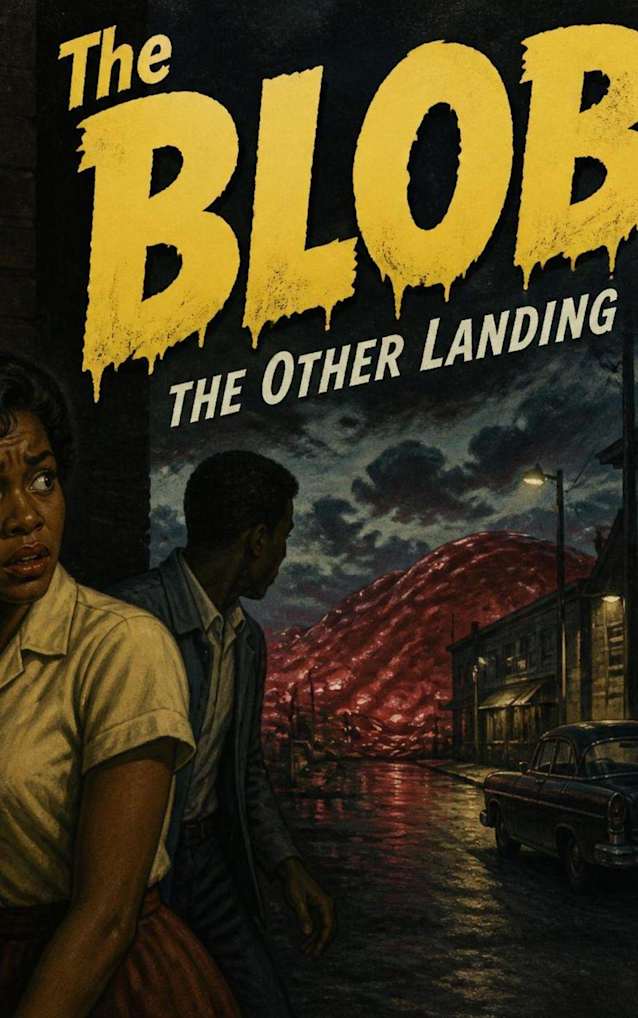
The Blob- The Other Landing (Tales From The Darker Side, #10)
About
When a meteor splits in the night sky, one fragment lands at the edge of a town, but the other crashes into the colored part of town where fear is quickly recognized, where the first victims vanish before the authorities even decide the threat is real. As the creature feeds in alleys, homes, and a juke joint near the racetrack, Joy realizes that this is not just another monster story—it is a test of whether her people can survive both the Blob and the old American habit of looking away from colored suffering.
With police and fire officials on the city side dismissing reports as hysteria and teenage nonsense, the Black residents are forced to organize their own defense under the leadership of Willis Joseph, Joy’s father and the community’s unofficial mayor. They are joined by Dr. Patricia Dawson, Joy’s brilliant aunt and a discredited Black scientist whose theories about a life-form built only to grow and consume were once rejected by a racist scientific establishment, but now may be the only key to stopping it.
The novel blends creature-feature suspense with historical horror, showing how segregation shapes who gets believed, who gets protected, and who must fight with little more than faith, memory, and each other. Colored veterans, church women, volunteer firemen, and schoolchildren all become part of the resistance, turning the community itself into the force that stands against an alien hunger no one else is willing to understand.
Trailer
Praise for this book
The Blob: The Other Side takes one of horror cinema's most familiar creature-feature premises and does something the original 1958 film never dared: it asks who else was standing at the edge of that meteor crater, and why history has never bothered to look. The result is a novel that functions simultaneously as a genre remix, a buried Black American history, and a communal survival story—one that centers the "colored side of town" as the true site of the fight, not a footnote to it.
A Familiar Monster, an Unfamiliar Frame
The novel's central move is deceptively simple: what if the meteor split, and the second fragment fell where history never looks? That question reframes the entire Blob mythos. Rather than a small-town sheriff and a lone teenage hero saving the day, kiney©️ builds an ensemble of church women, schoolchildren, volunteer firemen, and families like Joy Joseph's improvising defense with no institutional backing whatsoever. The shapeless, relentless, expanding menace becomes a metaphor readers will recognize instantly—a threat that arrives first, and worst, in the places the country has already decided not to protect.That structural choice does real work. By interrogating who suffered first and whose pain gets recorded, the novel taps into a much larger conversation about institutional disbelief of Black suffering—the same disbelief that shaped Reconstruction-era peonage, Jim Crow policing, and decades of segregated emergency response. The Blob isn't just a monster here; it's a stress test for a system already primed to abandon the community it lands on.
Veterans as Frontline Strategists
One of the novel's strongest choices is refusing to sideline its veteran characters. They are not background color or wounded-warrior tropes—they are frontline strategists and moral centers, carrying "old wars in their bones" into a new, unnamed one. kiney©️ draws a direct line between military service and the unfinished battles veterans return home to: segregation, neglect, bureaucratic indifference. The book states this plainly, describing "veterans who found another war waiting at home."That framing will land with particular force for readers with military backgrounds, because it validates something rarely said outright in genre fiction: that service doesn't end when the uniform comes off, and sometimes the next war is fought in alleys, churches, and neighborhoods no one is rushing to save. Watching battle-tested veterans repurpose their training and stand shoulder-to-shoulder with civilians against both the Blob and institutional apathy gives the novel its most emotionally grounded scenes.
The Weight of Memory and Faith
Elderly characters in the novel are treated with equal care and specificity. kiney©️ renders a segregated town with granular, lived-in detail—porches, radios in windows, church as sanctuary, a road that narrows and streetlights that thin once you cross into the "colored side of town." Informal leaders like Willis Joseph, who "becomes mayor without title because power abandoned his community long ago," embody a form of authority built entirely from necessity rather than official sanction.This attention to daily texture is what keeps the horror grounded. The Blob becomes a lens for revisiting long-standing realities—being disbelieved, organizing a defense with no help from outside, and relying on faith, memory, and neighborliness instead. The image of elders praying "in battle voices" while younger people haul freon rigs and rifles is one of the novel's most striking, giving older readers a role in the narrative as keepers of memory and spiritual backbone rather than passive bystanders waiting to be rescued.
A Cross-Generational Achievement
What makes The Blob: The Other Side especially effective is how deliberately it speaks to different readers without fracturing its narrative. Millennial readers, conditioned to distrust "official" narratives, will respond to the book's structural critique and its hints that "the government knows more than it admits." Veterans will recognize the tactical solidarity and the quiet acknowledgment of wars that never officially end. Elders will find their own remembered world rendered with respect rather than nostalgia alone.Across all three audiences, the novel performs the same essential move: take a familiar monster, drop it into a community already shaped by systemic horror, and let that community—not an outside hero—be the protagonist.
Final Assessment
The Blob: The Other Side succeeds as both loving genre homage and pointed historical corrective. By insisting that the overlooked side of town matters enough to be the center of the story, kiney©️ transforms a creature-feature premise into something closer to Kindred or Vadoo: Tales From the Darker Side—speculative horror used deliberately to expose what official history left out. The Blob may be the threat, but the real subject of the novel is who gets believed, who gets help, and who has always had to save themselves.