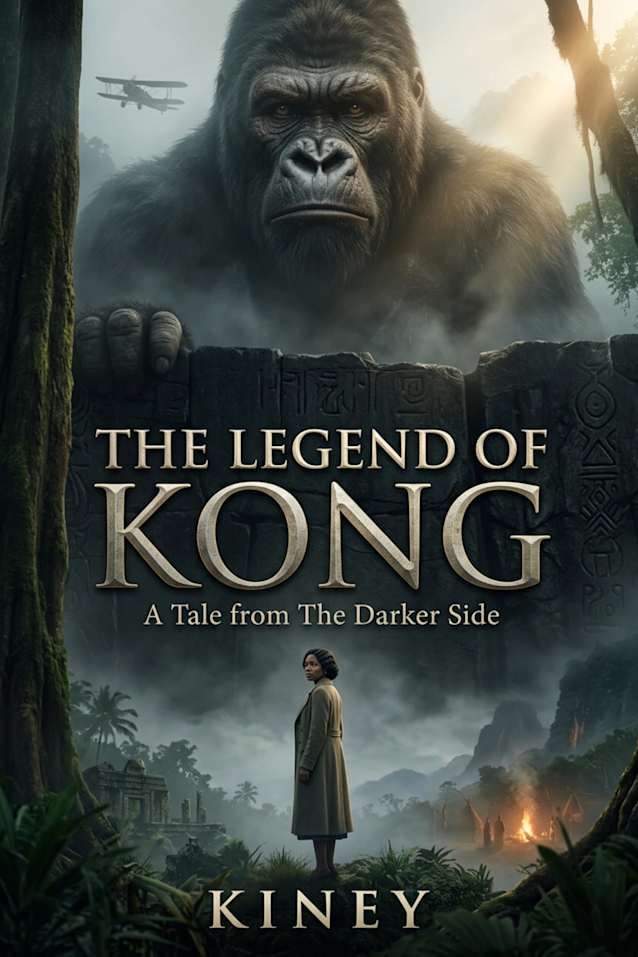
The Legend of Kong: A Tale from The Darker Side
About
When a Black actress is kidnapped and shipped to a mythic Pacific island by a Hollywood producer who wanted someone else, she discovers the island holds the secret of her mother’s disappearance — and a guardian who has been waiting for her daughter to return ever since.
The Setup
Los Angeles, January 1933. Depression-era Hollywood producer Kevin Joseph acquires ancient nautical charts pointing to an uncharted Pacific island teeming with prehistoric life and a sovereign, ape-like being he intends to exploit for a blockbuster film. He wants actress Natalie Coleman for the picture. But a crackling telephone line, a frightened nineteen-year-old errand boy, and three misheard letters change everything.
The call is for Natalie. What gets written down is Natasha.
Natasha Coleman — actress — is seized on a Tuesday evening on Central Avenue, mid-thought, carrying groceries and a half-finished poem about the color of the sky before dawn. She wakes on the Hikawa Maru, moving west. Her stylist and eleven-year friend Debra is taken alongside her.
The Island
The ship crosses into waters where compasses oscillate and chronometers lose minutes they don’t explain. They arrive at Skull Island — black sand beaches, impenetrable jungle, and a civilization no map acknowledges: the People of the Fall, descendants of both enslaved Africans and their captors, shipwrecked together in 1710 and marooned into something entirely new.
They have a composite language built from the ruins of other tongues — Twi, Dutch, English, Gold Coast memory — and a writing system unlike anything the outside world has recorded. And they have one question for Natasha: Are you the daughter of the woman who came from the sky?
The Mother
The woman from the sky was Bessie Coleman — Natasha’s mother, the first Black woman to earn an international pilot’s license, reported lost over the Pacific in 1922. The official record said engine failure. Natasha had never entirely believed it.
The Guardian
On the far side of a massive, mortar-free stone wall — forty feet of carved volcanic rock that geologically should not exist — lives the guardian. He is the last of his kind. Ancient, enormous, and possessed of a grief and gentleness for which the English language has no adequate word. He did not build the wall. He predates it. He has been waiting since Bessie’s death for the circle to close.
The wall divides the world: on one side, the People of the Fall and their fire, songs, and composite civilization; on the other, creatures from before the age of men — the place where time forgot to move.
Natasha’s Choice
Natasha walks off the ship. Not running — walking, with the deliberate gravity of a woman who has decided on a direction. She follows an ancient path through the jungle, joins the People of the Fall, and stands before the wall’s great central relief: the guardian, seated — not raging. Sovereign. His stone eyes holding light rather than reflecting it.
When the two finally meet — woman and guardian — it is not rescue. It is not captivity. It is recognition across the distance of grief: two beings the world insisted had no right to occupy the spaces they stood in, finally standing in the same one.
The Stakes
Kevin Joseph’s crew wants to capture the guardian and bring him to New York as a spectacle. The newspapers are already writing the story they plan to tell: monster, chains, civilization triumphant. that the oldest things left on earth are not dangerous because they are wild, but because they remember.
Thematic Core
The Legend of Kong is a reclamation of the 1933 King Kong mythology — restoring the Black women Hollywood erased and asking whose record survives, who gets to name what is monstrous, and what it truly means to return.
Trailer
Praise for this book
The Legend of Kong: A Tale from the Darker Side is a bold, lyrical reclamation of the King Kong myth—one that shifts the story’s center away from spectacle and toward memory, race, grief, survival, and the violence of who gets to control a narrative. kiney transforms Skull Island from an exoticized backdrop into a living archive, and Kong from a cinematic “beast” into an ancient guardian whose humanity exceeds that of the men who seek to capture him.
Set in 1933, the novel follows Natasha Coleman, a Black actress and poet kidnapped after a telephone error turns “Natalie” into “Natasha.” Her forced voyage to Skull Island connects her to a family history she believed had been lost: her mother, Bessie Coleman, survived her supposed disappearance and became “The First to Return” among the island’s people.
The novel’s most effective accomplishment is its refusal to accept the familiar King Kong narrative at face value. The story we know—of a monster seized from a distant island and made into public entertainment—is revealed as a manufactured version shaped by Hollywood, commercial hunger, racial fantasy, and colonial authority.
kiney positions the real horror not in the guardian himself but in the human machinery gathering around him: the producer who sees profit, the expedition that sees possession, and the press that turns a complicated truth into a sellable lie. The book’s recurring distinction between recording and lying gives its revisionist purpose moral weight.
Natasha is an especially strong anchor for this revision. She is thoughtful, observant, angry with purpose, and committed to language as a form of freedom. Her letters from captivity create intimacy and tension, while her identity as Bessie Coleman’s daughter makes the novel’s exploration of Black inheritance personal rather than merely symbolic.
The prose is richly literary, atmospheric, and deliberate. kiney writes in a style that often feels like oral history, folklore, gothic meditation, and historical fiction at once. The prologue immediately establishes the book’s central sensibility: this is a story concerned with the difference between a creature labeled monstrous and a world capable of making monsters out of people.
The island itself emerges as a character. Its black-sand shore, intentional fog, ancient wall, prehistoric ecosystem, and layered language give Skull Island a sense of depth that the conventional film myth rarely affords it. The People of the Fall—descendants of enslaved Africans and their captors shipwrecked together in 1710—are presented as a people who have made survival, language, and collective memory into a new world.
The guardian is rendered with equal care. Rather than a mindless terror, he is a being of enormous age, loneliness, restraint, and grief. One of the manuscript’s most resonant ideas is that he “chose, always, to step lightly”—a sharp contrast to the destructive human presence arriving to claim, catalogue, and exploit.
The Legend of Kong is a striking work of historical speculative fiction and gothic mythmaking. It does not merely retell King Kong; it interrogates the conditions that made the original story possible—racial exclusion, colonial fantasy, the commodification of the unfamiliar, and the ease with which powerful institutions replace truth with a marketable legend.
kiney’s novel is at its best when it insists that the past is not fixed by the version that became famous. In restoring Black women, cultural memory, and moral complexity to Skull Island, The Legend of Kong becomes a story about reclamation: reclaiming a monster, reclaiming an archive, and reclaiming the right to say what truly happened.