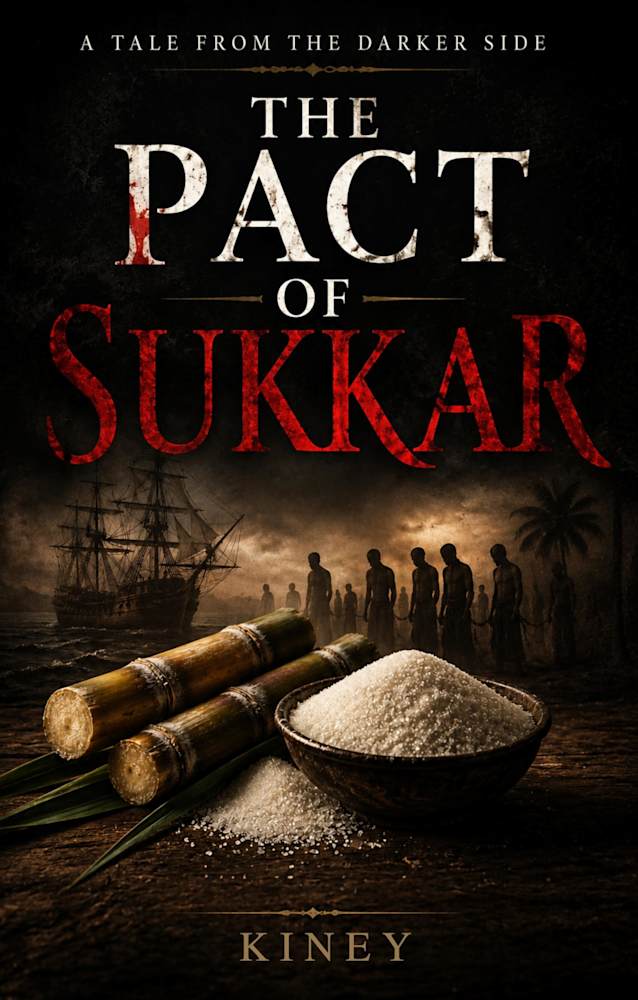
The Pact of Sukkar: A Tale From The Darker Side
About
The Pact of Sukkar: A Tale from The Darker Side is a historical gothic horror novel that traces the terrifying transformation of sugar from a sacred natural gift into a global instrument of conquest, slavery, greed, and spiritual corruption. When Captain Elias Thorne, an ambitious explorer driven by hunger for wealth and power, first tastes the crystalline sweetness known as sukkar on a lush island, he enters into a dark supernatural pact with a malevolent force hidden within the cane itself. In exchange for riches, influence, and dominion, Thorne agrees to carry sukkar into the world, no matter the human cost. What follows is the violent seizure of land, the destruction of native life, the rise of plantations, and the brutal reduction of people into property, all justified through the language of civilization, commerce, and religion. As the island is transformed into a machine of forced labor, suffering, and death, the survivors begin to understand that the true horror is not merely the demon attached to sugar, but the human systems that welcome and protect it. At the center of the story is Nala, a surviving island witness who refuses to let her people’s destruction disappear beneath the polished lies of empire. As priests, merchants, scholars, and soldiers attempt to bury the truth beneath doctrine, law, and profit, Nala and her allies fight to preserve an underground archive of memory—through names, songs, hidden records, whispered testimonies, and living witness. But as sugar’s reach expands beyond the island into trade, slavery, science, and global appetite, it becomes clear that the pact was never only with one man. It was with every institution willing to call theft ownership, bondage labor, and greed progress. In the novel’s devastating final movement, the island is destroyed by a combined military, ecclesiastical, and commercial assault, its people enslaved and scattered across the world. Yet even in ruin, the truth survives—carried in memory and resistance—while the demon of sukkar rises smiling over the wreckage, claiming its real prize: not simply death, but a civilization willing to sweeten itself with suffering. Dark, lyrical, and unflinching, The Pact of Sukkar is both a supernatural horror story and a brutal reckoning with the historical evils hidden beneath one of the world’s most desired substances.
Trailer
Praise for this book
The Pact of Sukkar: A Tale From The Darker Side is a historical gothic-horror novel that turns sugar into a symbol of conquest, enslavement, greed, and spiritual corruption. kiney’s central achievement is making something familiar—a spoonful of sweetness—feel haunted by the systems of violence that helped make it ordinary.
This is not horror built primarily on jump scares or supernatural spectacle. Its terror comes from the recognition that the demon in the cane does not create human cruelty; it finds human institutions already willing to bless, administer, profit from, and normalize it.
The horror beneath sweetness
The novel begins with Captain Elias Thorne arriving on a lush island and encountering sukkar, a sacred crystalline sweetness connected to the land, ritual, healing, and balance. When Thorne tastes it, he enters into a pact with a malevolent force that offers wealth, status, influence, and dominion in exchange for the destruction of the island’s autonomy and people.From that point, the novel treats sugar as far more than a commodity. It becomes an engine that transforms land into property, people into labor, culture into obstacle, and suffering into a profitable system. The cane’s demon is chilling precisely because it speaks in the language of human institutions: contracts, scripture, flags, ledgers, law, and commercial ambition.
One of the book’s most memorable ideas appears early: demons work best not through obvious claws or smoke, but through “polished words laid carefully over unbearable things.” That premise gives The Pact of Sukkar its moral and gothic power.
Empire as the monster
The novel’s most effective antagonist is not Thorne alone, though he is brutal and morally hollow. It is the expanding architecture around him: merchants, military power, Church authority, legal doctrine, plantation management, and the wider market that rewards each act of dispossession.kiney presents colonization as a process of renaming. Land becomes a holding or concession. Theft becomes order. Forced labor becomes productivity. Enslavement becomes administration. Indigenous sovereignty is erased through legal and theological language that defines the conquered as unworthy of ownership or self-rule.
The story’s supernatural elements intensify, rather than replace, this historical critique. The demon of sukkar embodies an appetite that is already social: the desire to make sweetness cheap, luxury ordinary, and profit invisible by placing the true human cost elsewhere.
Against the machinery of sugar, the novel places Nala and other survivors who protect the truth through names, songs, hidden documents, testimonies, and collective remembrance. That struggle makes the book more than a chronicle of devastation. It becomes a story about witness—about refusing to allow empire’s official record to become the final version of what happened.
This is where The Pact of Sukkar finds its deepest moral gravity. The survivors cannot always prevent the violence surrounding them, but they resist the second violence: historical erasure. Memory becomes an underground archive, and preserving it becomes an act of survival in its own right.
kiney’s prose is lyrical, incantatory, and deliberately severe. Short lines and repeated phrasing give the narration the cadence of a warning or sermon, particularly in the prologue, where sugar’s history is framed as “sweetness refined from suffering.”
The gothic imagery is especially effective when tied to systems rather than isolated scares: sugar dust covering the faces of carved saints, a chapel transformed into a site of judgment, the mill continuing to turn in the dark, and the dead returning as the unacknowledged foundation of wealth. These images make historical violence feel tangible without separating it from the economic and religious structures that sustain it.
Because the book’s moral argument is explicit, readers seeking ambiguity or a lightly drawn historical allegory may find its themes forceful. But the directness is intentional. The Pact of Sukkar insists that historical brutality is often made survivable for the comfortable through softened vocabulary, and it refuses that softening.
The Pact of Sukkar is a dark, imaginative, and politically urgent work of historical horror. It asks readers to see sugar not simply as an ingredient but as a metaphor for the systems that make pleasure possible by concealing suffering elsewhere.
Its most unsettling claim is also its most persuasive: the demon is not merely in the cane. It is in every institution and individual willing to call conquest discovery, bondage labor, theft ownership, and greed progress. By making that history supernatural, kiney does not make it less real—he makes its moral violence impossible to ignore.