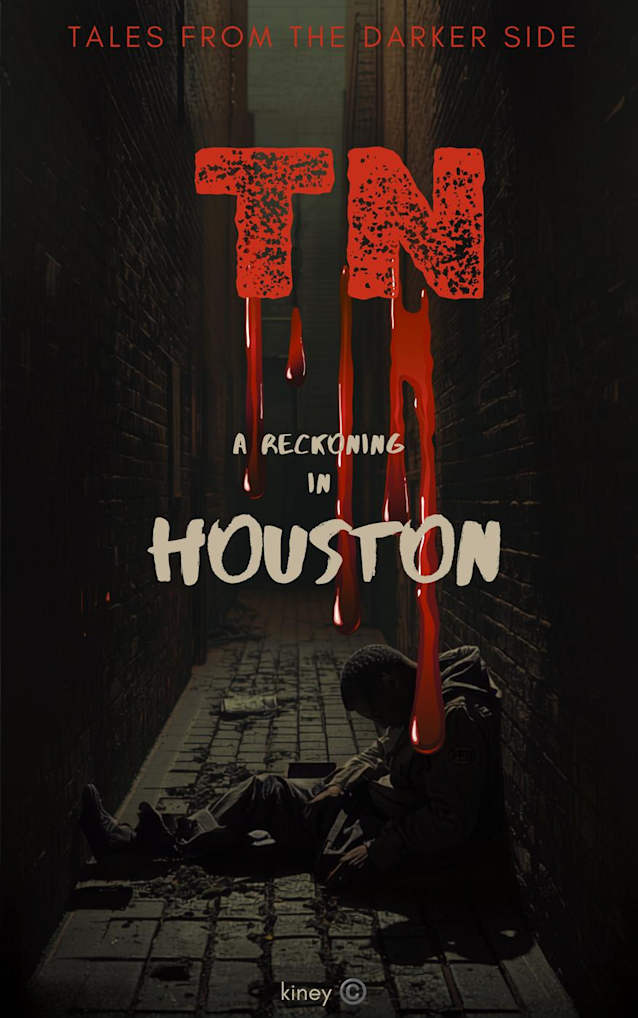
TN A Reckoning in Houston (Tales From The Darker Side, #4)
About
TN stands for “That Nigga” at the street level first, as the brutal shorthand used to reduce Doug to a disposable category rather than a person. Over time, it expands beyond one man into a symbol that neighborhoods, officials, and the city itself interpret in different ways, but the origin is that violent reduction of Black identity into a label.
TN is a gritty Houston thriller about Doug Johnson, a Black veteran whose life is shattered when he is brutally attacked and mistaken for someone marked by a hidden network of violence, power, and disposability. As he survives the beating, recovers, and begins tracing the men who ordered it, Doug discovers that the name “TN” is more than a street tag—it is a symbol of how the city, its institutions, and its underworld reduce certain people to categories rather than human beings. Moving through North Houston neighborhoods, alleys, motels, and back channels of influence, the novel becomes a tense reckoning with race, trauma, corruption, and the cost of being seen as expendable in a city that profits from forgetting.
This book was written from a place of witness, grief, and refusal. It is a work of fiction, but it is also shaped by the realities that Black veterans, crime victims, the displaced, and the forgotten know too well: how quickly a person can be reduced to a category, how easily institutions can fail the vulnerable, and how often the language of concern arrives after the damage is already done.
Some of the events, settings, and social pressures in this novel may feel uncomfortably familiar. That is intentional. Houston is not just a backdrop here; it is part of the book’s moral landscape, a city of beauty, ambition, contradiction, and unequal protection. The story asks what happens when violence is not treated as an interruption, but as something woven into the systems that claim to manage it.
At its center, TN is about visibility and disposability. It asks who gets believed, who gets blamed, who gets protected, and who gets written off. It also asks what it costs a person to survive injury in a world that wants only the simplest version of their pain.
If this novel unsettles, it should. But I also hope it honors those whose names were shortened, misread, erased, or replaced by labels that made neglect easier. This book is for them.
— kiney©️
Praise for this book
TN is kiney©️'s most formally daring work to date — a novel that begins as a vigilante mystery and steadily reveals itself to be something far more unsettling: an interrogation of what it means to be disposable in a city that has learned to administer its own violence rather than simply commit it. Set in Houston and centered on Dexter Broussard, a Black veteran assaulted and discarded by the machinery meant to protect him, the novel refuses the comfort of a clean revenge narrative even as it moves through the conventions of one.
Beyond the Beating
The novel opens, as its own foreword states plainly, with a beating — but it is "not finally about one beating." That distinction is the key to everything the book attempts. kiney©️ is not interested in isolating one act of violence for outrage; he is interested in "the grammar that makes certain beatings possible" — the quiet, distributed agreement across "boardrooms, patrol cars, neighborhood rumor, public policy, donor rhetoric, and ordinary fear" that some lives can be managed in category rather than encountered as full human beings.That is the novel's most sophisticated move: violence here is never presented as an aberration to be punished and then forgotten. It is presented as administration — an ambient condition a city finances and then calls unfortunate. Dexter's assault is not the crime the novel investigates. It's the symptom. The real subject is the machinery that produced the conditions for it and then declined to notice.
The Letters That Refuse to Stay Personal
The novel's title emerges from its own central tension. "TN" begins as initials attached to one man's reckoning, but the narrative deliberately erodes that containment. As the foreword states, the letters "gather meaning because the world around them has already been structured by disposability." What starts as a vigilante's mark becomes something closer to a diagnosis — a public symbol returning, "altered, sharpened, and made public," the very categorization that power used to erase people in the first place.This is a genuinely ambitious structural choice. Most vigilante fiction keeps its symbol fixed — a mask, a brand, a code name that means the same thing from chapter one to the finale. kiney©️ instead lets TN accumulate and destabilize meaning as the novel progresses, so that by the end, readers are left asking not "who is TN" but "what does a society's hidden grammar of disposability sound like when it's finally forced into speech."
Houston as Material, Not Metaphor
kiney©️'s choice of setting is deliberate and specific. Houston functions in this novel not as generic urban backdrop but as load-bearing material reality — "a city of floodwater and freeways, churches and contracts, resilience rhetoric and selective abandonment." The novel treats redevelopment and displacement as speaking "in the same voice," where public-private partnership can mean renewal from one vantage point and managed removal from another. Roads, motels, archives, patrol patterns, donor circuits, and storm systems all become part of the novel's moral architecture rather than mere scenery — grounding the book's abstractions in the concrete texture of a real, specific city.Refusing Easy Sanctification
What separates TN from a conventional vigilante thriller is its explicit refusal to let Dexter become a clean hero or TN become a symbol of permission. The novel is candid about "the terrible seduction of symbolic violence" — the way the abandoned may recognize themselves in a figure who names their disposability while simultaneously deepening the wound. TN produces both fear and relief, exposure and blowback, revelation and contamination, often in the same gesture. kiney©️'s decision to leave that contradiction unresolved, rather than resolving it into either condemnation or celebration, gives the novel genuine moral seriousness.The Dark Passenger as Survival Architecture
Dexter's internal "dark passenger" is handled with unusual care. Rather than treating it as a genre gimmick borrowed from other vigilante fiction, kiney©️ frames it as a question about what kinds of second selves oppressed and injured people are sometimes forced to build simply to continue existing. The novel deliberately refuses to cleanly separate trauma, training, dissociation, rage, spirit, historical pressure, and survival instinct — because, as the foreword notes, "real life often does not" separate them either. Dexter's struggle is framed not merely as guilt over what he has done, but as a reckoning with the self he had to assemble to survive a world organized against his full recognition.Visibility as a Double-Edged Sword
The novel's deepest inquiry concerns the relationship between visibility and danger. To remain unseen is to risk exploitation, disappearance, and administrative indifference. But visibility is no simple salvation either — it can trigger surveillance, repression, and the rapid conversion of lived suffering into "marketable or prosecutable narrative." kiney©️ articulates this with precision: the forgotten of the novel "do not merely seek to be seen. They seek to be believed without being consumed." That distinction — between being seen and being believed without exploitation — is one of the sharpest insights in any of kiney©️'s work to date.Final Assessment
TN resists easy genre classification by design. It is not a story about vengeance alone, though vengeance pulses through it. It is not only a thriller, though it moves through pursuit, exposure, and confrontation. It is not only social criticism, though it means to indict. It is, instead, a novel about category and residue — about how power names people and what happens when those names come back "altered, sharpened, and made public."The novel's closing question is its most enduring: "What kind of world requires so many people to survive as if they were already half-erased?" That kiney©️ refuses to answer it neatly — offering instead warning, lament, diagnosis, myth, accusation, and tragedy all at once — is precisely what makes TN one of the most morally serious entries in the Tales From the Darker Side catalog, standing alongside Vadoo and Reference Number 12007 as proof that kiney©️'s speculative and thriller instincts are strongest when aimed directly at the machinery of American disposability.