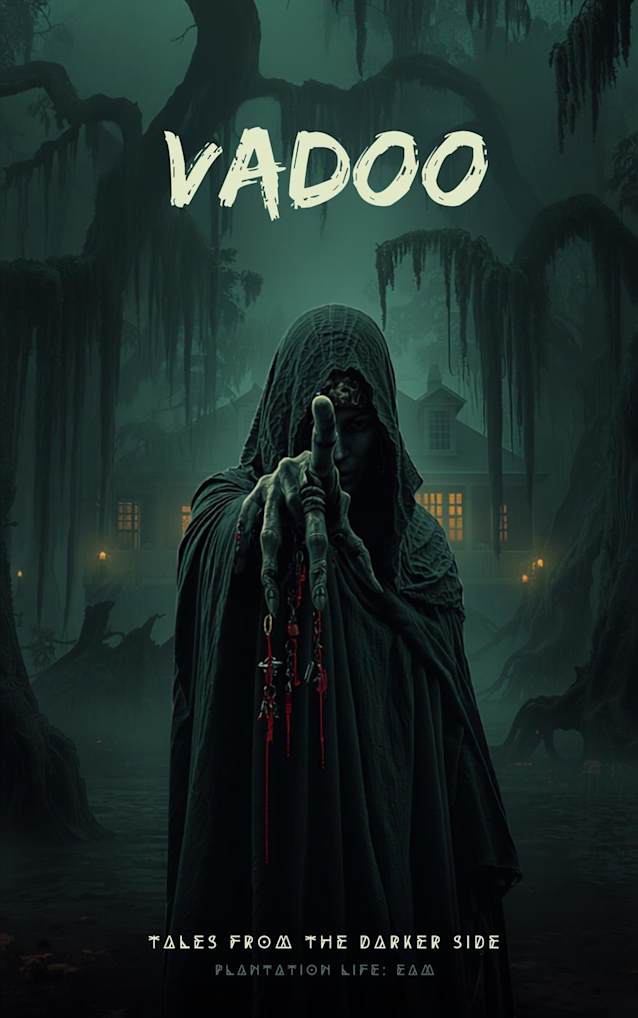
Vadoo- Episode One (Tales From The Darker Side, #7)
About
Vadoo is a dark speculative fiction collection rooted in horror, moral reckoning, and the buried violence of history. Through stories shaped by curses, hauntings, alternate realities, and ancestral memory, the book explores what happens when the past refuses to remain buried and those who have benefited from cruelty are forced to confront the human cost of power. At the center of the collection is Vadoo, a Southern Gothic tale of judgment, inheritance, and transformation. After a deadly act of violence sets an ancient curse in motion, Liam Barr—a man shaped by privilege, hatred, and generational arrogance—is forced into a brutal reckoning that strips away every illusion he has about race, innocence, family, and power. As he and those closest to him are drawn into a nightmarish alternate reality built on the naked logic of racial oppression, Liam must confront the same machinery of terror he once ignored, defended, or benefited from. But Vadoo is not only Liam’s story. It is also the story of Lorena, whose grief becomes a doorway to ancestral judgment; Elise, whose clarity and courage transform her from daughter into witness and leader; and the women, girls, and survivors who build resistance in a world designed to consume them. As curses deepen, families collapse, and hidden systems of exploitation are exposed, the story asks whether remorse can ever equal justice—and whether survival, truth, and collective resistance can break cycles older than memory. Blending Southern Gothic, speculative horror, supernatural justice, and political dystopia, Tales from the Darker Side is a meditation on historical violence, inherited guilt, and the terrifying power of memory when it finally speaks back.
Trailer
Praise for this book
Vadoo: Tales From the Darker Side is Black speculative fiction at its most confrontational — a novel that takes a bigoted white patriarch, strips away every layer of racial privilege that has shielded him, and forces him to live inside the exact fear and violence he has spent his life inflicting. It belongs on the shelf beside Octavia Butler's Kindred, not as imitation, but as a natural extension of the same tradition: using speculative displacement to make racial power impossible to look away from.
A Curse Born From Blood and Land
The novel centers on Liam Barr, a white man in Delcroix, Louisiana, whose hatred of his Black neighbors, the Washington family, curdles into greed and then into murder once he learns the land he sold them may sit atop valuable mineral deposits. Liam's actions — engineering a fatal collision that kills Bobby, Camille, and Marci Washington — set the novel's supernatural mechanism into motion. Lorena Joseph's dying whisper, "Let him enter what he made," becomes both curse and verdict.The morning after, Liam wakes to find his skin, and the skin of his entire family, transformed. Not stained, not costumed — irreversibly Black. kiney©️ handles this transformation with genuine narrative discipline, refusing to let it become a simple gimmick. The horror isn't the change itself; it's watching Liam's town, his bank, his social circle, and eventually the American legal system reorganize around him the instant his body no longer reads as white.
Social Death Rendered in Granular Detail
What elevates Vadoo above a straightforward "message" story is its granular attention to how quickly institutional trust evaporates. Sherry can't cash a check because tellers "think she's pretending to be herself." Elise is removed from a prom-planning group chat and renamed "voodoo princess" in another. The Rotary banquet is quietly postponed. None of these moments are dramatic on their own — that's precisely the point. kiney©️ shows disposability as bureaucratic and social reflex, the same insight that animates his novel TN: violence doesn't need spectacle when exclusion, suspicion, and withdrawal of trust can do the work just as effectively.The traffic camera footage that reopens Bobby Washington's death as a homicide investigation lands with devastating irony — the same institutions Liam once trusted to protect men like him now examine his identification "as if fraud had become his natural condition."
Nightmare as History, Not Metaphor
The novel's boldest structural choice is dropping Liam directly into a nightmare version of the antebellum South — not as vision or dream sequence, but as lived, physically dangerous reality. Miss Odessa's warnings ("Do not go out after dark. Do not travel alone. Never look white people in the eye") function as a survival manual Liam must learn in real time, with real consequences. The hunting-camp sequence, where Colonel Nugent and armed men pursue Liam's family through the woods with dogs and searchlights, is the novel's most harrowing set piece — precisely because it forces Liam to experience, viscerally, the exact terror his own hatred once trivialized as "witchcraft" and "Negro sorcery."kiney©️ resists easy catharsis even here. When Liam kills Nugent and later corners three hunters at gunpoint, the prose refuses to let it feel triumphant. Liam recognizes his own violence reproducing the same grammar of cruelty he claims to be escaping — "another man proving the world right about what pain should produce."
A Reckoning, Not a Redemption Arc
Vadoo is most effective in what it withholds. This is not a story about a bigot who suffers and emerges enlightened. Liam's transformation exposes moral cowardice at every level of his family — his father Chuck's naked admission that he sacrificed his own son as "bait" for the hunters is one of the novel's most chilling scenes, precisely because it shows that whiteness protecting itself will abandon even blood when convenient. Liam's daughter Elise becomes the novel's moral conscience, refusing to let her father's suffering erase his responsibility: "I know Marci is dead. I know Bobby is dead. Camille is dead. And now the town knows you lied."Where It Sits in Black Speculative Fiction
Vadoo earns its place in the Black Sci-Fi tradition not through futuristic technology but through the genre's oldest and sharpest tool: using the impossible to expose what's true. Where Butler's Kindred pulls a Black woman backward into slavery to reveal how unfinished that history remains, kiney©️ inverts the mechanism — pulling a white supremacist forward into the consequences of the world he defended, forcing him to inhabit Blackness as lived vulnerability rather than abstraction. Both novels refuse comforting distance. Both insist that history is not safely past.Final Assessment
Vadoo: Tales From the Darker Side succeeds because it never lets its speculative premise soften into simple poetic justice. Liam's punishment doesn't purify him — it reveals him, and it reveals the machinery of a town, a family, and a legal system built to protect whiteness at any cost. For readers of Kindred, American Nightmare, or kiney©️'s own TN and Reference Number 12007, Vadoo offers the same unflinching question in a new register: what happens when the very fear a man weaponized against others becomes the only truth left standing in his own mirror?