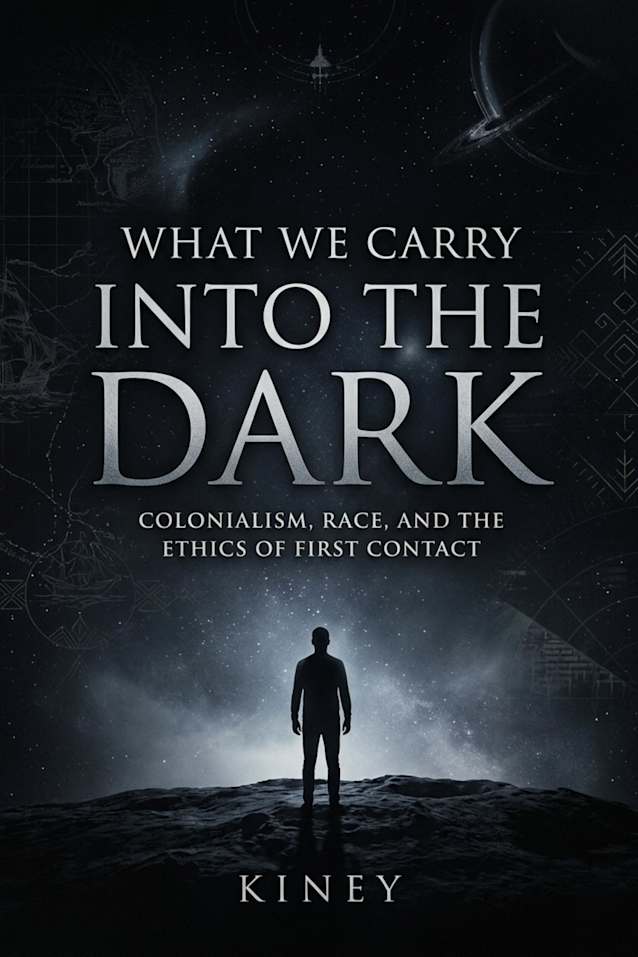
What We Carry Into the Dark: Colonialism, Race, and the Ethics of First Contact
About
What We Carry into the Dark: Colonialism, Race, and the Ethics of First Contact What would happen if extraterrestrial intelligence made contact with humanity tomorrow? The instinctive answer reaches for technology, diplomacy, and science. The honest answer reaches further back—into the centuries of conquest, extraction, and cultural erasure that have defined how humanity has always responded when it encountered the genuinely other. What We Carry into the Dark is a work of speculative nonfiction that argues the most urgent question about humanity’s cosmic future is not whether we will make contact, but whether we are morally prepared for it. Drawing on history, international law, Indigenous epistemology, sociology, military experience, and the enduring philosophical legacy of Star Trek, author kiney makes the case that a civilization which has not reckoned honestly with its colonial inheritance cannot engage ethically with any intelligence it finds beyond this planet—because it will carry that inheritance with it, whether it intends to or not. The book moves through six chapters and a suite of framing pieces—Prologue, Foreword, and Epilogue—that together build a comprehensive and unflinching examination of the mechanisms through which colonialism continues to shape our institutions, our language, our legal frameworks, and our deepest reflexes about who deserves dignity and who is available for use. Chapter by chapter, the book constructs its central thesis with historical precision and moral urgency- This places it firmly in the speculative nonfiction tradition alongside works like Carl Sagan’s Pale Blue Dot, Naomi Klein’s The Shock Doctrine, and Robin Wall Kimmerer’s Braiding Sweetgrass.
Trailer
Praise for this book
What We Carry Into the Dark: Colonialism, Race, and the Ethics of First Contact is an ambitious work of speculative nonfiction that asks readers to reconsider the moral meaning of humanity’s movement into space. Its central argument is clear and forceful: before we imagine how we would meet extraterrestrial intelligence, we must confront the colonial, racial, economic, and militarized habits we would bring into that encounter.
Rather than treating first contact as a technological puzzle or a science-fiction spectacle, the book frames it as an ethical test. It argues that a civilization unable to practice dignity, reciprocity, and justice among its own people is poorly prepared to encounter a profoundly unfamiliar “other.” That premise gives the work urgency well beyond its extraterrestrial setting.
Strengths
The manuscript’s greatest strength is its unflinching connection between historical colonialism and contemporary space discourse. It examines how terms such as “frontier,” “settlement,” “development,” “discovery,” and “manifest destiny” can carry older assumptions about entitlement, possession, and conquest. The book does not argue that all space exploration is inherently colonial; instead, it asks readers to recognize how easily colonial patterns can be reproduced when power, wealth, technology, and governance are concentrated in the hands of a few.Its discussion of Indigenous land-right principles is particularly compelling. By foregrounding relationality, stewardship, reciprocity, co-governance, and Free, Prior, and Informed Consent, the book presents Indigenous knowledge systems not as symbolic additions to space policy but as serious ethical frameworks for planetary governance. This gives the text practical stakes: it moves beyond critique and challenges institutions to build enforceable systems that put consent and accountability before extraction.
The author also uses Star Trek effectively as both inspiration and critique. The Prime Directive becomes a lens through which to examine noninterference, power imbalance, cultural autonomy, and the gap between utopian ideals and present-day political reality. The personal reflections on watching a future that often excluded Black people from its imagined cosmos add emotional force and clarify why representation is not merely a cultural matter—it shapes who is imagined as belonging in the future.
Style and Impact
The prose is passionate, direct, and often eloquent. Lines such as “The universe is not a frontier waiting to be claimed. It is a commons we have not yet learned to deserve” capture the project’s moral vision and give the work a memorable rhetorical identity. The author writes with the urgency of someone who sees history not as distant background but as an active force shaping law, language, institutions, and imagination.The book’s perspective is also distinctive. It draws together military experience, Black history, Indigenous rights, space law, political critique, and science-fiction philosophy. That interdisciplinary approach allows the work to speak to readers of speculative nonfiction, Afrofuturist and decolonial thought, military studies, space-policy ethics, and socially engaged science fiction.
Considerations
At times, the manuscript’s strongest ideas recur in similar language across chapters: colonialism’s legacy, the danger of “othering,” the inadequacy of current governance, and the need for ethical preparation. These repetitions reinforce the thesis, but tightening some passages could increase momentum and make each chapter’s distinct contribution stand out more sharply.The book would also benefit from a more formal source apparatus—endnotes, citations, a bibliography, and clearer differentiation between historical record, policy analysis, scholarly interpretation, and speculative extrapolation. Because it makes substantial claims about space law, Indigenous governance, colonial history, and contemporary space institutions, rigorous documentation would strengthen its authority for academic, policy-minded, and general nonfiction audiences.
Verdict
What We Carry Into the Dark is a thoughtful, provocative, and necessary intervention in conversations about humanity’s future beyond Earth. Its most powerful insight is that first contact begins long before an alien signal arrives: it begins in the ways people distribute power, recognize humanity across difference, govern shared resources, and confront the histories embedded in their institutions.This is not conventional science writing, nor is it a simple celebration of exploration. It is a moral reckoning—one that insists the real question is not whether humanity can reach the stars, but whether it has done the work required to arrive there responsibly.