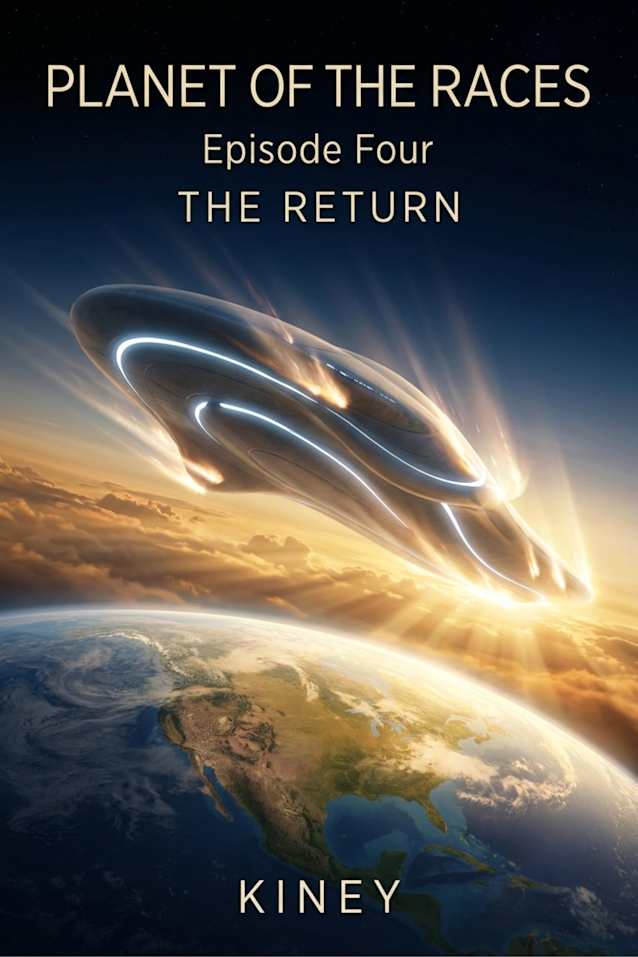
Planet Of The Races Episode 4: The Return
About
The children have returned. The world they left behind has not.
One year after twelve teenagers departed Earth aboard an alien vessel, they finally come home—changed in ways no one could have imagined. They carry knowledge that could transform humanity forever, but they return to a planet divided by politics, fear, secrecy, and the consequences of choices made during their absence.
As governments scramble to control the truth, old enemies resurface, hidden agendas collide, and humanity faces a defining moment. Every revelation forces a difficult question:
Can a civilization survive knowing what it truly is?
Planet of the Races: Episode Four – The Return continues the acclaimed science fiction saga with unforgettable characters, philosophical depth, political intrigue, first-contact mystery, and emotional storytelling.
Perfect for readers who enjoy intelligent speculative fiction, character-driven science fiction, alien civilizations, and thought-provoking stories that explore humanity’s future.
In this episode you’ll discover:
- Humanity’s first reunion with the children who lived among an advanced alien civilization.
- Political conspiracies and global tension.
- Deep philosophical questions about civilization, identity, and truth.
- Powerful character development and emotional reunions.
- A cinematic continuation of the Planet of the Races series.
The return is only the beginning.
Trailer
Praise for this book
Episode 4 of Planet of the Races, The Return, is where the series cashes in its emotional and political wagers. The children come home from Lara changed, and the world they return to has doubled down on its refusal to listen, especially to the Laranians’ proposal for genuine, transformative contact.
Roni’s Transformation
This episode belongs, in a very specific way, to Roni. He returns from Lara carrying a medical framework he built himself from what the Laranians showed him, a body of knowledge that arrives at the precise moment when Earth’s institutions are fighting over who gets to own and control knowledge in the first place. Roni isn’t just “a kid who went to an alien planet” anymore; he’s a seventeen-year-old whose understanding of healing, systems, and embodiment has outgrown the structures that produced him, and the episode makes you feel the weight of that. His change is quiet but radical: he thinks differently, sees differently, and understands that what he carries now belongs to a future his own civilization may not be ready to accept.A World That Refuses to Listen
While Roni and the other children return carrying hard-won insight, Earth’s response to the Laranian proposal remains locked in fear and self-protection. Sixty-two days of “managed institutional crisis” have produced a world more dangerous and more honest, but not more receptive. The consortium letters have gone out. The trial is running. Joy is in a hospital bed doing invisible, essential mental work. The Laranians have offered a way of seeing ourselves that could move humanity across a threshold, and the dominant reaction is still resistance, delay, and control rather than curiosity or courage.Colonel Braddock and the Anti-Alien Machine
Colonel Braddock embodies that resistance. He is the voice willing to say the “unsayable thing” out loud, the institutional figure who turns fear of the Other into policy and public narrative. Through Braddock and the broader anti-alien movement, the episode explores how easily a civilization can weaponize uncertainty, turning genuine contact into a perceived threat that must be neutralized rather than understood. The anti-alien movement isn’t just background noise; it’s the machinery that tries to strip the children’s experience of legitimacy before it can change anything, and The Return shows how devastating that machinery can be when it meets a young person like Roni who has no institutional protection and only a few weeks before the system discovers what he knows and moves to claim or crush it.The Cost of Being Seen
At its core, Episode 4 continues the series’ central question: what does it cost a civilization to be truly seen, and can it survive knowing what it is? The Laranians didn’t come to evaluate us from a distance; they came to look directly, with full attention, and to teach the children to do the same in return. The Return is the episode where that double vision comes home and collides with a world organized around not seeing itself. Roni’s growth, the world’s disregard for the proposal, and Braddock’s entrenched anti-alien stance all converge into a sharp, character-driven critique of how species-level fear can overpower the very opportunities that might save us.For readers invested in first-contact stories that are really about race, power, and institutional control, Planet of the Races: Episode 4 — The Return delivers a tense, thoughtful chapter that feels painfully close to our own world, even when the beings in the room aren’t human.