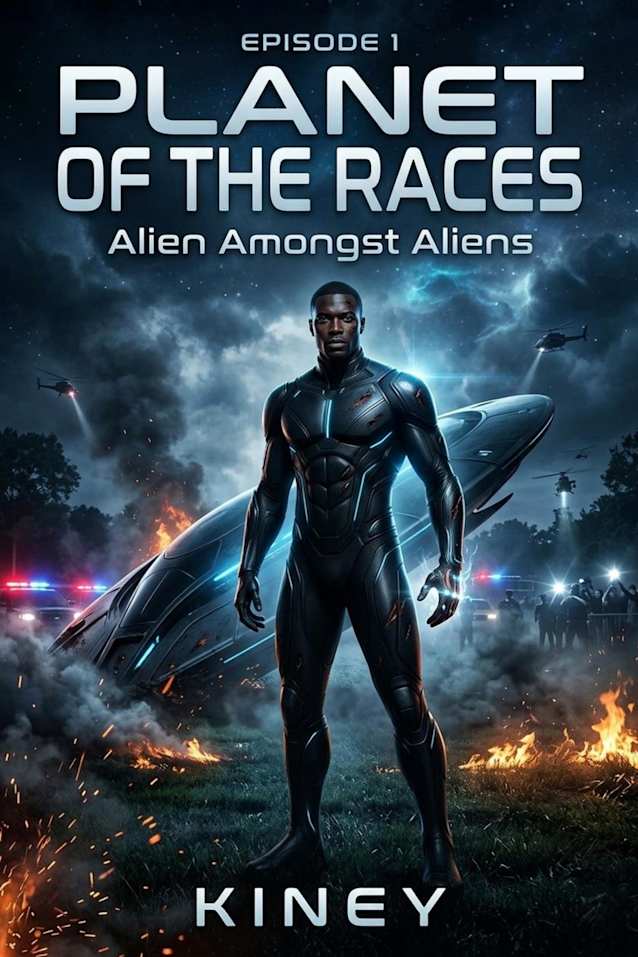
Planet Of The Races- Episode One- Alien Amongst Aliens
About
When Joy Joseph, a woman from Opelousas, Louisiana, crosses paths with ⨰i⋲, the first extraterrestrial being ever to arrive on Earth, her life is pulled into a dangerous conflict between truth and power. ⨰i⋲ is not an invader, a terrorist, or the hostile fugitive the government claims he is. He is a stranded traveler trying to recover his ship and return home. But to the powerful men who seize control of his story, ⨰i⋲ is something far more valuable: a weapon, a biological prize, and the key to unimaginable military dominance. At the center of that conspiracy stands Colonel Braddock, a ruthless strategist operating through classified channels linked to America’s anomaly-response apparatus. Publicly, Braddock frames ⨰i⋲ as a grave national-security threat. Privately, he intends to capture, exploit, and if necessary, kill the first alien ever to set foot on Earth before the American people learn the truth. His obsession deepens when he gains access to ⨰i⋲’s extraordinary combat suit, a near-invulnerable piece of alien technology capable of reshaping warfare and global power forever. As surveillance closes in, Joy becomes ⨰i⋲’s fiercest protector. With the help of Rufus, a brilliant and unpredictable young ally, and an expanding grassroots resistance network known as Team Red, she transforms her home into a command center for truth-telling, legal resistance, and survival. What begins as a cover-up in rural Louisiana quickly becomes a battle over who gets to define first contact: the people, or the state. Complicating matters further is Special Agent Frederick Douglas Johnson, a disciplined federal investigator assigned to examine the growing scandal. Initially tasked with helping contain the situation, Johnson gradually uncovers evidence that the official case against ⨰i⋲ has been manufactured. As he draws closer to Joy, professionally and emotionally, he is forced to confront the widening corruption inside the very institutions he serves. In Joy, he finds not only a witness, but a woman whose moral clarity challenges everything he believes about loyalty, law, and justice. The conflict escalates from hidden surveillance and political manipulation to open violence when Braddock abducts Joy and launches a final assault wearing ⨰i⋲’s stolen combat suit. But Braddock’s greatest mistake is believing that possession equals mastery. In a stunning five-second confrontation in Port Barre, ⨰i⋲ effortlessly shuts down the suit, trapping Braddock inside his own stolen armor and ending his reign of terror. With Joy saved and Braddock captured, ⨰i⋲ finally recovers his ship and sends a distress signal to his home world. The response is immediate: a rescue vessel is already on its way. Its commander carries a message not only for Joy, Johnson, and ⨰i⋲, but for the entire United States. Within thirty-six hours, an extraterrestrial delegation will arrive in Opelousas, Louisiana, requesting to speak directly to the American people—and to their president. Blending political conspiracy, Black Science Fiction, Black Southern identity, military intrigue, first-contact suspense, and a love story forged in crisis, this novel explores who gets called human, who gets called dangerous, and what happens when the truth survives long enough to speak for itself.
Trailer
Praise for this book
Planet of the Races opens with one of the strongest first-contact premises in recent speculative fiction: a stranded alien whose survival depends not on outwitting humanity's technology, but on surviving humanity's instincts. Episode One, "Alien Amongst Aliens," crash-lands its protagonist ⨰i⋲ into Houston's Memorial Park and, within a single night, forces both character and reader to confront a brutal question — what does a species reveal about itself in the first moments it meets something it doesn't understand?
A Crash Landing That Doubles as a Mirror
The episode opens with visceral urgency: a black, seamless vessel tears through the atmosphere and slams into the park, leaving a burning crater and a wounded pilot. ⨰i⋲, a disciplined operative from far beyond the solar system, wakes with broken ribs, failing equipment, and a single priority — survive long enough to repair his mission. From that opening image, kiney©️ establishes the episode's central device: everything that happens to ⨰i⋲ becomes a diagnostic instrument, testing not the alien, but the world receiving him.That framing is stated explicitly in the series foreword: "Every story of first contact reveals more about the world that receives the visitor than about the visitor himself." ⨰i⋲ comes from a Laranian culture where conflict yields to comprehension, and war belongs to "the deep shame of forgotten ages." His first hours on Earth become a study in contrast — a species capable of cities, global networks, and councils, yet one that still greets the unknown with "superheated metal hurled at flesh."
Kindness and Violence in the Same Breath
The episode's most effective choice is refusing to let humanity off easy or condemn it outright. EMT Mike Edwards drops into the crater and treats ⨰i⋲ as a patient rather than a threat, becoming the first human to read his need instead of his danger. Their exchange carries real warmth — Mike's weary humor about his own mortality and mortgage humanizes him even as sirens close in and phones flash overhead like "false stars aimed at a wounded alien."Then the gunfire starts. A bullet screams past the wreckage, and ⨰i⋲ doesn't duck — he has no frame of reference for a weapon that compresses violence into something this small, fast, and remote. His breakdown of what he's witnessing is the episode's sharpest piece of writing: "They throw heated metal... propelled with force... concealed at distance." In a few words, kiney©️ turns a familiar action-scene beat into an indictment of how casually humans have industrialized killing.
That juxtaposition — Mike's compassion inside the crater, gunfire raining down from outside it — is where the episode's thesis lives. Individual humans can offer instant kindness to a stranger. Human institutions, represented here by Colonel Braddock and the converging command apparatus, instead see ⨰i⋲'s body as a national asset before they see him as a person at all.
A Familiar Pattern, Deliberately Echoed
The foreword also signals where the series intends to go: toward "communities—like Joy Joseph's—who recognize, in his treatment, a pattern they already know: being misnamed, misused, and weaponized by power." That's a bold structural choice. Rather than treating first contact as a purely science-fictional event, kiney©️ is positioning ⨰i⋲'s ordeal as a continuation of a recognizable history — one where perceived otherness invites suspicion, seizure, and violence regardless of intent.This connects Planet of the Races to the same tradition running through kiney©️'s other work: using speculative displacement to expose how power responds to difference. Where Bet examines what a man will trade for the life he wants, and Vadoo forces a bigot to inhabit the fear he once inflicted, Planet of the Races widens the lens to an entire species' reflexive answer to the unknown.
Craft and Pacing
The episode moves with tight, controlled urgency. kiney©️ resists the temptation to over-explain ⨰i⋲'s technology or backstory, instead letting the reader learn alongside him — the translator device sputtering to life, his tactician's read of human faces "split between awe and fear," his growing understanding delivered in fragments rather than exposition dumps. The closing image is the episode's strongest: ⨰i⋲'s subconscious defense field flaring to flatten a bullet mid-flight, a moment that lands not as a triumphant power reveal, but as confirmation of a grim verdict — he cannot rely on human restraint to survive.Final Assessment
"Alien Amongst Aliens" succeeds because it refuses to resolve its central tension. Humans in this episode are neither monsters nor heroes; they are a species capable of both instantaneous grace and reflexive violence, often within the same few minutes. That refusal to simplify is exactly what the series foreword promises, and Episode One delivers on it fully: not a story about what aliens will do to us, but a story about what our answer to the unfamiliar says about who we already are.For readers of Octavia Butler's Kindred or kiney©️'s own Vadoo: Tales From the Darker Side, this episode offers a familiar emotional register in a new genre skin — speculative fiction used not to escape history, but to hold up a mirror to it.