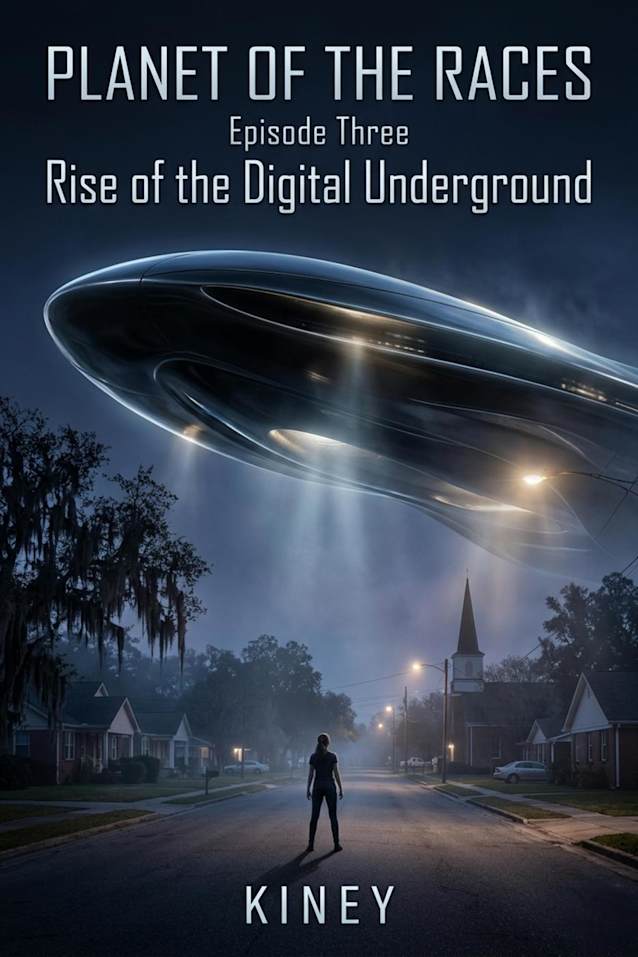
Planet Of The Races- Episode Three- Rise of The Digital Underground
About
After first contact shatters the old order, a hidden network of hackers, activists, veterans, and ordinary citizens rises to challenge the systems of surveillance, deception, and state power tightening around humanity’s future. Known only as the Digital Underground, they fight to expose buried truths, defend the vulnerable, and resist a world where information is controlled and dissent is criminalized. In this gripping new chapter of Planet of the Races, the real war is no longer only in the skies—it is in the data, the narrative, and the human soul. While the world is still processing the shock of the Laranian landing and the one hundred ninety-six chosen children are somewhere above the atmosphere beginning their year on Lara, the institutions that manage knowledge, security, and power on Earth are moving faster than the public knows — and in the neighborhood where Jerome watches his nephew’s empty chair at the dinner table and his sister Joy navigates the dangerous proximity of having been a civilian witness inside the AAOR’s facility during ⨰i⋲’s detention, a different kind of institution is being built in the spaces the official ones don’t occupy. Rise of The Digital Underground is the origin story of the network that will matter most when the children come home — told from the inside, through the people who built it not in response to the landing but in response to the decades of extraction, suppression, and structural exclusion that made the landing’s aftermath inevitable the moment the ship touched down. Jerome is at the center, making the first calls, connecting the community health workers and research librarians and former whistleblowers and independent archivists who understand that the next battle over who controls what humanity knows will not be fought in courtrooms or boardrooms but in the infrastructure built quietly, carefully, and without institutional permission in the years before anyone thought to look. Claudette is there from the beginning. The unregistered phone is acquired. The practices are established. And by the time the episode ends — eleven years before Roni steps off a Laranian ship carrying a notebook in his left jacket pocket — the Underground is already waiting for him
Trailer
Praise for this book
Planet of the Races: Episode 3—Rise of the Digital Underground is the trilogy’s most intimate and politically searching installment. kiney shifts the focus from the spectacle of first contact to its aftermath: what happens when a child becomes visible to the world, when institutions compete to define him, and when communities must decide whether protection means care, control, or possession.
This is speculative fiction with a serious moral center. The alien arrival matters, but the novel’s deepest concern is human: who is watched, who is believed, who is turned into a symbol, and how families preserve a child’s humanity when public attention becomes another form of danger.
A Different Kind of Sequel
Despite its title, Rise of the Digital Underground is not simply a technological-resistance thriller. It is a story about hidden systems—surveillance networks, institutional routines, community channels, social-media attention, and even ostensibly protective structures—that can become intrusive when they treat vulnerable people as information rather than as persons.The prologue establishes this tension with precision. A child has been “noticed” by multiple systems, each debating how his life might be used: displayed, studied, protected, or managed. The novel’s crucial insight is that harm often begins not with an overt attack but with access, monitoring, and language that makes extraction sound like opportunity.
The Digital Underground itself is therefore morally complex. It can function as mutual aid, archive, resistance network, shield, and community intelligence system. But kiney refuses to romanticize secrecy. The book recognizes that any hidden network—even one built to protect—can become dangerous when it loses accountability, consent, and ethical restraint.
The Laranian Mirror
The Laranian address to Earth provides one of the novel’s most forceful sequences. The visitor tells humanity that it is “one people” behaving as though it were “many species,” challenging racial hierarchy, institutional inequality, and the ways societies assign danger, innocence, and worth before a child has spoken.The line “Not bad. Unfinished” becomes the book’s governing moral idea. It rejects the comfort of declaring humanity irredeemable while refusing the equally convenient fiction that progress has solved structural harm. The Laranian’s demand is not merely for better language or good intentions, but for repair: truth, responsibility, and the deliberate construction of conditions in which old injuries cannot repeat themselves.
kiney also wisely gives this moment a child’s point of view. The young narrator’s question—“Are people here bad?”—cuts through official speeches and adult defensiveness. His understanding of “unfinished” through homework, half-completed household projects, and everyday family life turns a large political idea into something immediate and emotionally legible.
Family, Visibility, and Harm
The novel is strongest when it returns from public spectacle to the home. The parents’ response to their son’s sudden national visibility is loving, frightened, and believable. They understand that viral attention can convert a child into a public argument, and that praise can be as distorting as hostility when it pushes someone too young into the role of representative, hero, or symbol.Scenes involving online comments, unsolicited messages, media pressure, and the arrival of a news van make that threat concrete. kiney captures the invasion of ordinary life: a child who only asked a question suddenly finds his image circulated, his family home treated as a backdrop, and strangers interpreting his words for their own political purposes.
The father’s gift of a blank notebook is a quiet but powerful countermeasure. It gives the child a private place to hold his own questions before “the world starts trying to hand you theirs.” That small gesture distills the book’s ethical position: people need witness and community, but they also need privacy, agency, and the right not to become public property.
Verdict
Rise of the Digital Underground is a thoughtful, emotionally grounded conclusion that broadens the trilogy’s vision of resistance. Its real revolution is not a weapon or a secret network—it is the insistence that people, especially children, must remain more than the data, fear, narratives, and expectations imposed upon them.kiney’s most persuasive achievement is making the future feel close to home. The novel asks what happens after the ship arrives, after the speech ends, after the cameras turn toward a child’s face—and it answers that the struggle for justice continues in schools, kitchens, churches, neighborhood streets, family conversations, and the difficult work of refusing to let anyone else own the story of your life.