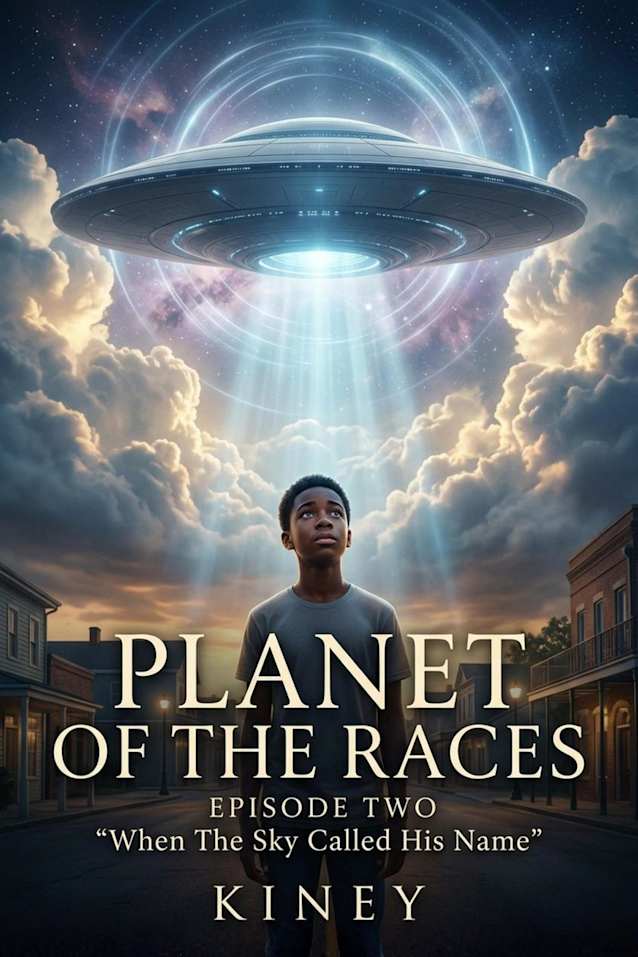
PLANET OF THE RACES EPISODE TWO When the Sky Called His Name
About
Planet of the Races: Episode 2 – When the Sky Called His Name is a sweeping, emotionally powerful science-fiction novel about grief, healing, destiny, and the possibility that humanity might still become worthy of peace. In a world transformed by first contact, Roni Joseph, a brilliant Black teenager from Opelousas, Louisiana, is chosen for something greater than anyone around him can fully imagine. Shaped by family loss, hardship, and the burden of expectations placed on boys like him, Roni carries both private sorrow and a deep, restless hope for something beyond survival. When an alien civilization from the planet Lara announces that a select group of Earth’s children will travel across the stars to learn the secret of peace, Roni feels as though the universe itself is calling his name. To the world, the invitation is a historic global event. To Roni, it is personal. He believes whoever goes to Lara must represent more than politics, power, or carefully crafted national images; they must carry the truth of human pain, endurance, dignity, and hope. But just as that future begins to open before him, tragedy strikes, leaving him hospitalized and paralyzed after a brutal hit-and-run. What follows changes everything. Visited by the mysterious Commander J’kote and miraculously healed, Roni rises from his bed to discover that he has been chosen as the final child to join the mission to Lara. As he boards the alien vessel and leaves Earth behind, he becomes more than a wounded boy from Louisiana—he becomes a symbol of humanity’s unfinished promise and its fragile chance to choose unity over division.
Praise for this book
Planet of the Races: Episode 2—When the Sky Called His Name expands its science-fiction world into a deeply personal story about grief, dignity, family, and the right to be seen as fully human. kiney places Roni Joseph—a gifted Black teenager from Opelousas, Louisiana—at the center of a global first-contact crisis, making the cosmic feel intimate and the intimate feel world-changing.
Where the earlier installment establishes the political consequences of alien contact, Episode 2 focuses on what it costs ordinary people to stand inside history. The result is a moving, ambitious middle chapter that treats first contact not as escapism, but as a test of whether humanity can become worthy of peace.
Story and Stakes
The Laranians arrive not as conquerors but as observers of a divided world: a species capable of beauty, science, family, and devastating cruelty. Their offer is as hopeful as it is unsettling—selected children from Earth will travel to Lara to learn the conditions for peace, while humanity is given a limited period to confront its divisions.Roni’s journey provides the novel’s emotional core. He carries the accumulated pressures of family loss, a father taken by war, a brother struggling with addiction, and the narrow expectations placed on Black boys in America. His desire to travel to Lara is not simply personal ambition; he wants to represent the truth of people whose struggles are routinely ignored or softened for public comfort.
The novel intensifies that journey through tragedy. A hit-and-run leaves Roni paralyzed, apparently ending his dream just as it begins. The subsequent healing and his selection for the mission elevate him into a symbol, but the book works best when it remembers that he is first a child and a son—someone whose worth must not depend on whether he can walk, perform heroism, or fulfill anyone else’s expectations.
What Works
kiney’s strongest choice is locating the epicenter of interstellar history in Louisiana rather than in a generic laboratory, military base, or distant capital. Opelousas becomes more than a setting: it is a place with memory, faith, community infrastructure, and experience with power arriving late and expecting obedience. Mayor Joyce Tyler Stevenson and Joy embody this local insistence that Black residents cannot be reduced to background figures in a story unfolding on their own land.The Laranian arrival sequence is also effective. A mile-wide vessel descends over southern Louisiana while military and political institutions struggle to name what they cannot control. Commander J’kote’s question—“Which of you speaks for Earth?”—cuts through the spectacle and exposes the gap between official command and moral legitimacy.
The novel’s political imagination is direct. It critiques surveillance, militarized secrecy, the conversion of first contact into a national-security asset, and the habitual tendency of institutions to treat the vulnerable as resources rather than people. The “DiGital⧗uNdeRgRouNd”—a network of coders, veterans, archivists, church members, and everyday citizens—offers a counterweight: collective action rooted in documentation, mutual aid, and truth-telling.
The novel sometimes explains its political meaning very explicitly, leaving limited room for readers to infer the allegory on their own. A few scenes could become even more powerful through greater compression and more dialogue-driven conflict. Still, the directness is part of kiney’s intention: this is not science fiction interested in neutral distance. It is science fiction that wants to name injustice, claim Black presence in the future, and insist that progress without moral change is not progress at all.
Verdict
When the Sky Called His Name is an emotionally charged, politically conscious science-fiction novel about a Black child called into cosmic history. Its real question is not whether aliens can save humanity, but whether humanity can learn to save itself—by recognizing dignity, protecting the vulnerable, and refusing to let power monopolize truth.